

In the classical liberal view, the American Revolution is a victory for all Americans. Our patriotic story, which is ingrained in every Yankee youth from an early age, frames America’s violent founding as a necessity to free our collective and individual destinies from the British Monarchy. With the altruistic heroes of George Washington, Thomas Jefferson, and Alexander Hamilton at the helm, progressive forces steered history towards a more advanced stage of society. By freeing itself from the shackles of feudal monarchy, the United States of America advanced not just its own interests, but those of everyone who toils and troubles under the yoke of subjugation. This American Legend is the centerpiece of our iconography. Archibald Willard’s The Spirit of '76 commemorated the revolution’s 100th birthday with a disheveled but unyielding George Washington look-alike leading Old Glory through the musket smoke into bluer skies. Young and old patriots alike look to the protagonist for courage as he marches forward armed only with a drum. The fixed bayonets of the Continental Army follow the band, the artist’s depiction of America as a nation founded foremost on ideas and sentiments, not cannon and musket.
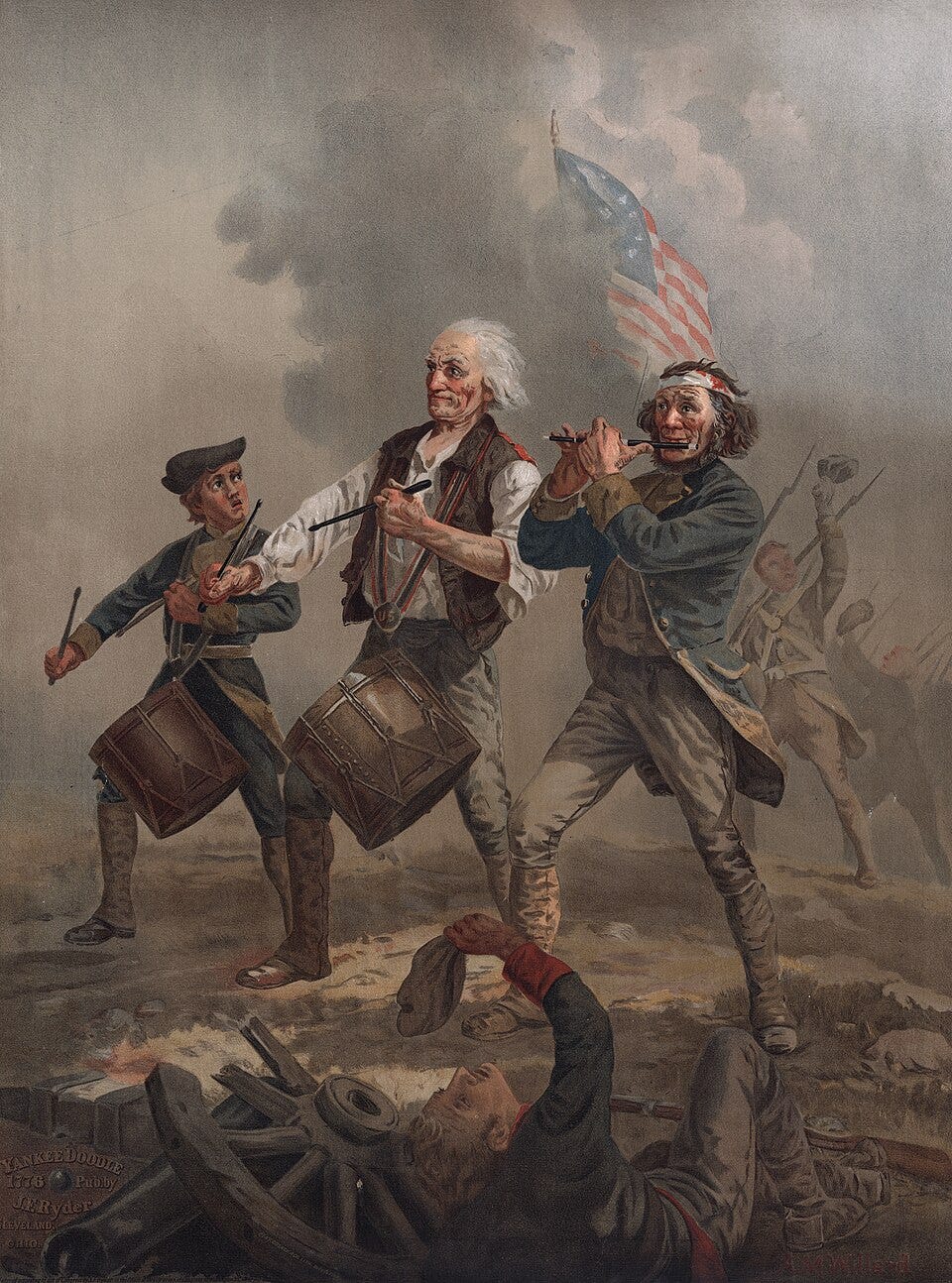
Though reassuring, this rosy story is incomplete. It’s hard to square a national identity of liberty and equality with things such as, you know, slavery, genocide, the subjugation of women, and any other crime you can find by opening any history book to a random page. American propaganda doesn’t outright excuse these atrocities. Rather, it argues that the Founding Fathers were blinded by their primitive age, an unfortunate happenstance that hindered them from delivering the true equality promised by their feathered pens. Though the 18th-century founders did not live up to their promise of liberty for all, fortunately, their genius transcended their age. Born of the Enlightenment’s egalitarian ideas, the Founding Fathers created the optimal system of democratic governance that would enable future generations to overcome their missteps. As the story goes, their contributions to the Declaration of Independence, the Constitution, and the Bill of Rights laid a path to utopia. And all we Americans must do is walk it. Former President Barack Obama, perhaps the greatest modern proponent of American mythology, drew from this national story during his recent remarks at the opening of his presidential library.
“In forming our union, the founders fell terribly short of the Declaration's promise, leaving slavery intact, allowing states to restrict the franchise to white men who owned property. But in drafting a Constitution and a Bill of Rights, they did have the foresight, the genius, to provide us with a framework that allows each generation to make our union more perfect."
Though too oversimplistic for my taste, this view isn’t entirely wrong. There is no American Revolution without the Enlightenment, and the establishment of political democracy and anti-monarchical sentiment has greatly benefited the well-being of modern American citizens. While the 1776 revolution was a welcome development, it was neither decolonial nor liberatory. Grains of truth underlie Obama’s speech. But ultimately, this classical liberal view misreads history and leaves us with a false understanding of how contemporary progressive forces must grapple with the legacy of 1776 to establish a truly democratic republic.
For Better or Worse, A Bourgeouise Revolution
By overemphasizing the relevance of ideas and underemphasizing the importance of competing class interests, the classical view of the American Revolution leaves us unequipped to combat the modern issues of Republican Fascism, Democratic complacency, capitalist oligarchy, destructive climate change, and everything else that gives you a panic attack every time you read the news. Though Enlightenment ideals were present, the American Revolution was driven first and foremost by the economic and prestigious desires of the American aristocracy.
