

Earlier this week, Substack announced it was rolling out Polymarket embeds as part of its expanding partnership with the sportsbook. Sorry, the “Prediction Market,” which is how Polymarket and its competitor Kalshi describe themselves. As part of the launch, Substack CEO Chris Best repeated Polymarket’s marketing pitch that prediction markets are a helpful social tool for aggregating real-time data to estimate the likelihood of an event. From his announcement:
What are prediction markets, and why do they matter?
Prediction markets are an emerging technology that aggregates real-time estimates of what will happen in the future. While the stock market lets people trade shares of companies, and the price reflects an estimate of how much a business is worth, Polymarket lets people trade shares of future events, like elections, economic trends, and scientific breakthroughs. The price reflects a market estimate of how likely an outcome is to happen.
This is false. I’m extremely disappointed that Substack has partnered with Polymarket. Not just because they’ve turned their platform into a gateway drug to highly-addictive online gambling, but because they’ve chosen to repeat the nefarious lies Polymarket uses to misrepresent itself.
Here are five things you need to know about Polymarket and other “prediction markets.”
#1. A “prediction market” is just a legal loophole. By classifying themselves as “prediction markets” instead of “sportsbooks” and calling their wagers “event derivatives” instead of “bets,” Polymarket and Kalshi have successfully placed themselves under the regulation of the Commodity Futures Trading Commission (CFTC), as opposed to state gambling commissions. Restrictions are lighter, there’s less oversight, and they don’t need an actual gambling license. Plus, it’s unclear how exactly these sites are taxed, and whether they pay into gambling addiction resources, such as the infamous 1-800 number. Essentially, these companies argue their platforms are more like the stock exchange than FanDuel. Polymarket withdrew from the U.S. after Biden’s CFTC challenged it in 2022, but then Trump’s CFTC approved its reentry last December.
#2. Polymarket and other “prediction markets” are just sportsbooks. Over 90% of prediction marketing betting activity is on sports. So, while Substack describes Polymarket as a way to “trade shares of future events, like elections, economic trends, and scientific breakthroughs,” there’s very little of that. Real-world event betting is how Polymarket attracts non-sports bettors to sign up for the platform. Then they will push them to start betting on sports, where they make most of their money. So, while a non-betting Slow Boring reader might take the newsletter’s advice of an election outcome and decide to place a wager through the sponsored plug-in, Polymarket will soon start blasting them with marketing and promotional emails that drive them to bet on NBA, NFL, and MLB games. It’s a pipeline to addiction. Also, Polymarket pretends its real-world event betting is what distinguishes it from sportsbooks. But offshore sportsbooks (unregulated and illegal in the US) have always offered bets on elections, movies, politics, and more. In the sports betting world, these are called “dummy lines,” for obvious reasons.
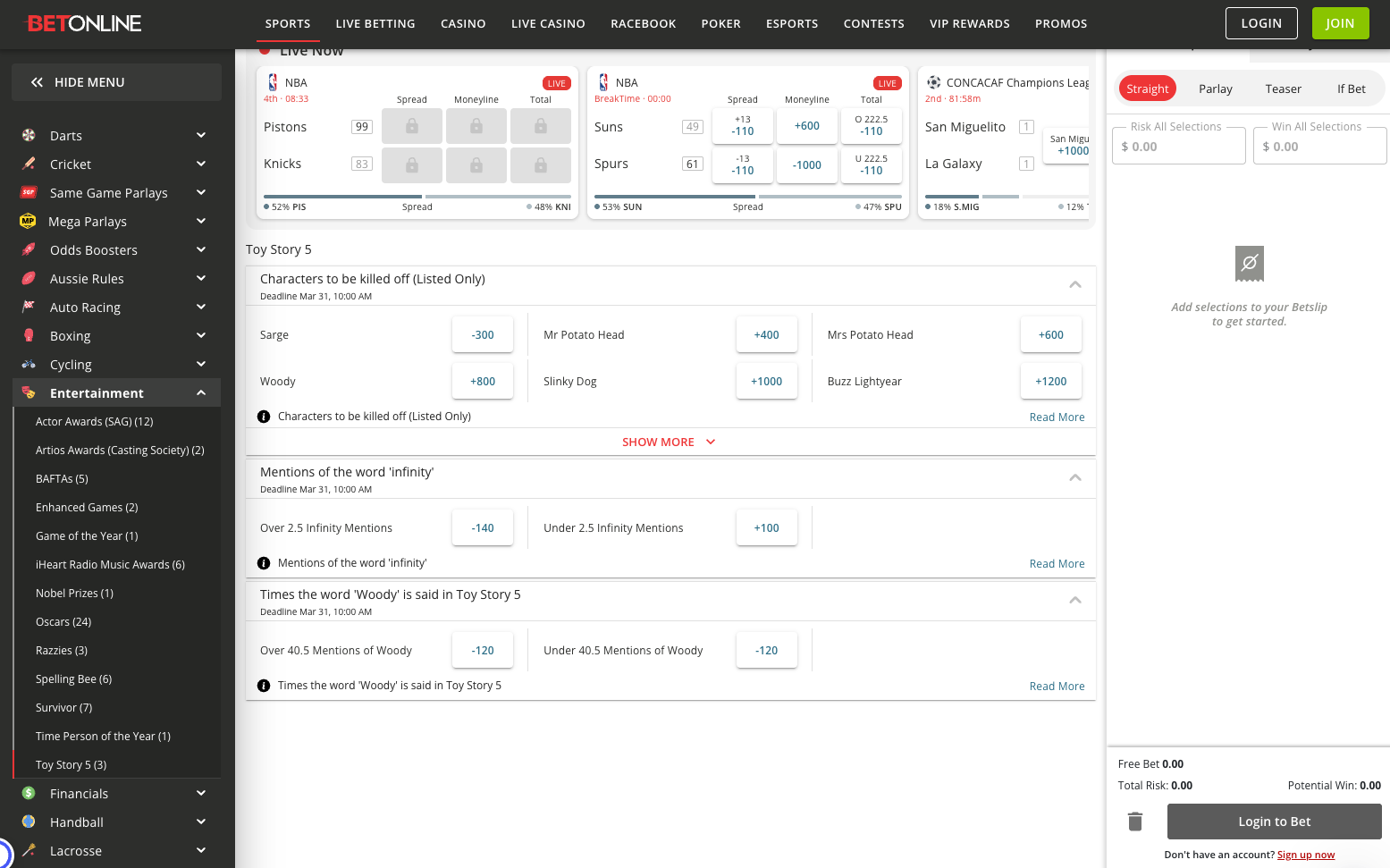
#3. Polymarket makes its own rules. For all my complaints about online sportsbetting, which should be outlawed, wagering on real-world events is way more problematic than wagering on sports. The results of an athletic competition, and by extension all the bets, aren’t determined by the actual sportsbook, but the league. When the Red Sox vs. Yankees game ends, the MLB publishes a final scorecard with the official result, runs scored, strikes thrown, batter hits, and every other game and player stat that people bet on. (Which is all of them.) This information is used to settle bets on sportsbooks such as FanDuel and DraftKings. If there’s a dispute between a bettor and a book, the state gambling commission will settle it by pulling the league’s official scorecard. Having gone through this process, it’s long and annoying, but at least there’s imparital truth. And sportsbooks honor the commission’s decision because they want to keep their license. But for real-world events bet on in prediction markets, there is no official legal scorecard or gambling commission. Polymarket decides whether you win or lose. And you can bet everything you have they’ll decide whatever puts them on top. For example, when the U.S. invaded Venezuela and kidnapped President Nicolas Maduro in January, Polymarket refused to pay out to bettors who wagered the U.S. would “invade Venezuela.” The gambling site argued the operation didn’t constitute an “invasion.” According to the terms of service, Polymarket says the bet was decided by “a consensus of credible sources.” Whatever that means.
#4. Real-world events are often pre-determined outcomes. Betting scandals have rocked the sports world, and they are all but guaranteed for non-sports betting. Take a look at Kalshi’s mission statement:
Think about it - Kalshi lets you take something as subjective as a celebrity rumor (”Is Kendall Jenner pregnant?”) and turn it into a concrete number – a price. It’s like capturing a fleeting thought and giving it a form you can analyze and discuss.
Suddenly, the messy world of opinions becomes a structured market. This forces us to refine our beliefs, consider all sides of the issue, and ultimately, gain a sharper understanding of the world around us.
Imagine - differing viewpoints become focused negotiations. Kalshi isn’t just about predicting the future perfectly; it’s about actively engaging with uncertainty. It’s about turning a difference in opinion into a concrete action – a trade.
This is nonsense! It is not an “opinion,” “subjective,” or an “uncertainty” if Kendall Jenner is pregnant. She either is or isn’t! Certain people already know that information and will inevitably use it to game the market. I’m sure a small circle knows whether a Jenner is pregnant, but Polymarket and Kalshi offer bets on predetermined events known to vast numbers of people. Here’s Chris Hayes sharing a story of how people were betting on what he would say during The Tonight Show, hours after he had already taped it.
As expected, those with insider knowledge are using their information to fix bets. Israel recently arrested multiple soldiers for using classified information to bet on markets pertaining to the genocide in Palestine, and an anonymous bettor placed a $400,000 winning bet on the U.S. kidnapping Maduro while the operation was underway. Bet-fixing doesn’t just impact the person who did it. It invalidates the entire market. If a million people bet on “How many times will Chris Hayes say ‘China’ on The Tonight Show?” and one crew member who knows he’ll say it ten times bets a million dollars, that changes the pricing and odds for everyone who placed a wager. I don’t even know if I can call this betting fixing, because people aren’t fixing it. Polymarket is just letting them bet on already-decided events to maximize their profits.
#5. Betting lines don’t give an accurate portrayal of real-life probability. Contrary to Polymarket’s public relations push, these are not a way to understand an event’s probability or spread knowledge. At least sportsbooks don’t pretend to be your friend. But Kalshi and Polymarket offer some of the most disingenuous missions and marketing I’ve ever read. All of the prediction market marketing is packaged as if they are benevolent products that can help common folk like you and me better understand the world and achieve informational parity with the elites. Here’s Kalshi’s top lobbyist, former Biden administration staffer and Senior Democratic Congressional Campaign Committee official John Bivona:
At a time when people feel like our financial system is rigged against the everyday person, Kalshi levels the playing field and brings more public participation to the issues that people care about most.”
Here’s how Polymarket describes itself in its Substack, The Oracle:
We are in a misinformation pandemic. Our feeds are ranked algorithmically and promote only the most incendiary and addictive content. The pundit class have proven themselves unable to grapple with the complex world we live in.
As a consequence, trust in institutions, and with it our shared sense of reality, is on a multi-decade downtrend. Prediction markets are the best tool we have to fight back against bullshit, clickbait, and propaganda. They work by rewarding participants who make good predictions, and punishing those who don’t.
This is such dishonest bullshit. Obviously, these companies are not here to help you. They’re here to take as much of your money as possible, and they have no issue ruining your life and leaving you in crippling debt. Furthermore, odds making, the practice of determining what a bet’s price should be, is not fully determined by the bettors. Polymarket likes to pretend that an odds price provides real-time information on an actual likelihood, a way to “make journalism better,” as Substack claims. But this isn’t how line-making works. Every sportsbook, casino, and prediction market has line makers. These are professional odds makers who have more information about every possible bet than you ever could. Using extensive software programs, financial data, weather forecasting, satellite imagery, and a million other sources of information that you and I could never get our hands on, they set lines for Polymarket to ensure the house always wins. They might not always win the bet, but the lines are made to ensure the house profits over time, and the bettors lose over time. Now, if the public starts betting heavily on one side of a line, say everyone bets “Yes, Israel will violate international law and annex Gaza by June 30th, 2026,” — which we can see below in this nifty embedded genocide tracker from Substack — then the line will move, and the price will be adjusted. (This is why a win/lose bet is called a “monyeline.” The money pushes the line.) But this is just one small factor odds makers use to determine the likelihood. It is not even the largest factor, nevermind the entirety of it.
So, while Substack likes to pretend the Polymarket feature will “make journalism better,” that’s not how this sponsorship will work. Polymarket will not make journalism better, for the same reason it won’t make anything better. It doesn’t want to. Polymarket only wants to make money. And it does so in the most exploitative, deceptive way possible.
I’m really sad to see Substack promote the Polymarket partnership and feature. There are a lot of bullshit tech companies out there, solving fake problems with fake solutions. Substack isn’t one of them. I’m not a huge writer, but I am closing in on 10,000 subscribers, which I’m proud of, considering I began with no name recognition, social media presence, or credentials. I’m the exact user Substack built its platform for — just a guy to start writing, and if people liked it, they could support me. In addition to the ethical concerns of launching a sportsbook partnership, I worry that this Polymarket integration shows Substack is no longer thinking about its original user. I was under no illusions about their mission. This company exists to make a profit. But I believe they’ve been successful towards that goal because they’ve stayed true to the original mission. For the first time, the sponsorship with Polymarket is forcing me to ask if promoting good writing and helping writers build is still Substack’s mission.
Ah, gambling. Taking advantage of people who don’t understand math since, well, forever.
My late father-in-law was a civil engineer who helped design the streetlight system in Las Vegas. His job entailed staying in a hotel across from one of the big casinos during the week.
He told this great anti-gambling cautionary tale about how every day, he’d watch the armored truck pull up at the casino and the guards would wheel out the money and put it in the armored truck. He said in all the time he was there, he never once saw them take money INTO the casino.
There’s a lesson there about gambling, and it doesn’t take a rocket scientist to figure it out.
Oh what do you know, Substack is doing something shady and shitty!!!! Shocker :/ BTW I moved my publication over to Beehiiv, happy to share insights with anyone who wants to leave Substack.