

China is an enigma in American politics. Hawkish politicians from both parties want to frame the Asian nation as the next Soviet Union — a colossal superpower seeking conquest and dominance. We’ve heard a lot about a “New Cold War,” and the media continues to push the potential for a hot war on its readers. Some leftists accept this framing and look to China as a savior who will vanquish the American Empire. Neither one of these is true. The term “campist” is usually thrown at leftists who support America’s geopolitical rivals. In reality, the most dedicated campists are those pushing the frame of a New Cold War from within the “pro-democracy" camp (which includes Israel, so take ‘democratic’ with a grain of salt). The problem with campism, both the large and powerful American kind and the small and powerless leftist kind, is that the world isn’t in “camps.”
For all the talk of China being a “communist” country, it’s not. At the 19th conference of the Chinese Communist Party (CCP) in 2018, President Xi Jinping outlined a two-step vision for China. The first step is “socialist modernization” from 2020 to 2035. This would set the stage for the second phase (2035 to 2050), in which China would be turned into a “modern socialist country that is prosperous, strong, democratic, culturally advanced, harmonious, beautiful, and reasonably pollution-free.” 2050 has been the Chinese communists’ target for establishing socialism since 1987. At that year’s Party conference, the CCP declared that China was in the middle of a hundred-year primary stage, which began in the 1950s (the start of Communist Party rule) and would run until 2050. The 1987 declaration broke Marxist-Leninist doctrine and declared that the primary contradiction — i.e., problem — in China wasn’t between the workers and capitalists, but between underdeveloped China and the developed world:
“The primary task is to energetically expand the commodity economy, raise labour productivity and gradually achieve modernisation of industry, agriculture, national defence, science and technology.”
The CCP recommitted to this vision at the 20th Party Conference in 2024. So, what does this make China?
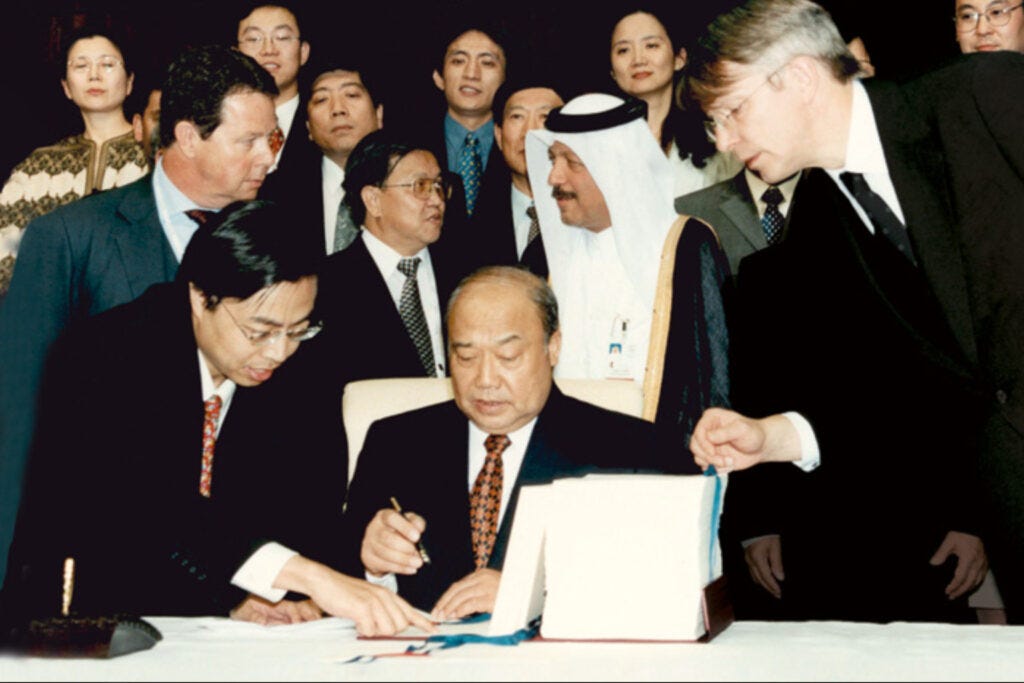
The Party still describes China as “Socialism with Chinese characteristics,” but those characteristics are very much capitalist. After the disastrous Great Leap Forward, Mao resigned as President in 1959. Aided by Deng Xiaoping, the new President, Liu Shaoqi began to liberalize the economy, particularly with food imports. After Mao died in 1976, Deng consolidated political power and rapidly expanded China’s openness under the Dengist theory, a combination of Marxist-Leninist one-party control with elements of neoliberal capitalism. China officially entered the international capitalist order by joining the World Trade Organization in 2001 with full American support.
Currently, China is a state capitalist country. There is private enterprise, entrepreneurship, and a labor market. Business owners hire laborers, who work for a wage. What separates China’s capitalism from American capitalism is the role of the state. Neoliberal systems like ours view the state’s job as creating the appropriate conditions for private enterprise to flourish. The American government sets minor regulations such as environmental practices and a minimum wage. But for the most part, it steps back and lets Musk, Bezos, and Zuckerberg cook. In China, the state oversees investment and large enterprises. State-owned enterprises dominate heavy industry, including telecommunications, military production, nuclear power, banking, and artificial intelligence. Some of these companies have reached enormous heights on international stock exchanges, blurring the line between socialism and capitalism. Even private companies are influenced by party cells, autonomous management units within the corporate structure that represent the CCP’s interests. There are also tighter regulations for private enterprises, which neoliberal say is unfair. Yea, that’s the point. The Chinese Communist Party prioritizes collective control over private control, so it tips the scales in the former’s favor. It’s common for the CCP to welcome foreign capital to compete in a particular sector, then support the winner with state subsidies and control. Critics and supporters will debate endlessly whether the market introduction is capitalism or socialism, good or bad, genius or betrayal. But what is undeniable is that it’s working.
Earlier this year, the CCP announced the start of its 15th five-year plan. (I know. Lots of plans, visions, periods, etc. The Chinese are nothing if not particular.) This plan accelerates Xi’s vision by moving the Chinese economy away from cheap manufactured goods and towards a leading industrial powerhouse. Basically, China wants to produce less of the plastic crap sold on TikTok Shop and more cutting-edge technology. In preparation for this five-year period (2025 to 2030), China waived its “special and differential” treatment at the WTO. This category is designed to give developing countries a leg up in resource sourcing and trade. Beijing’s willingness to forgo this privilege shows CCP leadership believes they can drop the economic training wheels. The result indicates they’re correct.
