

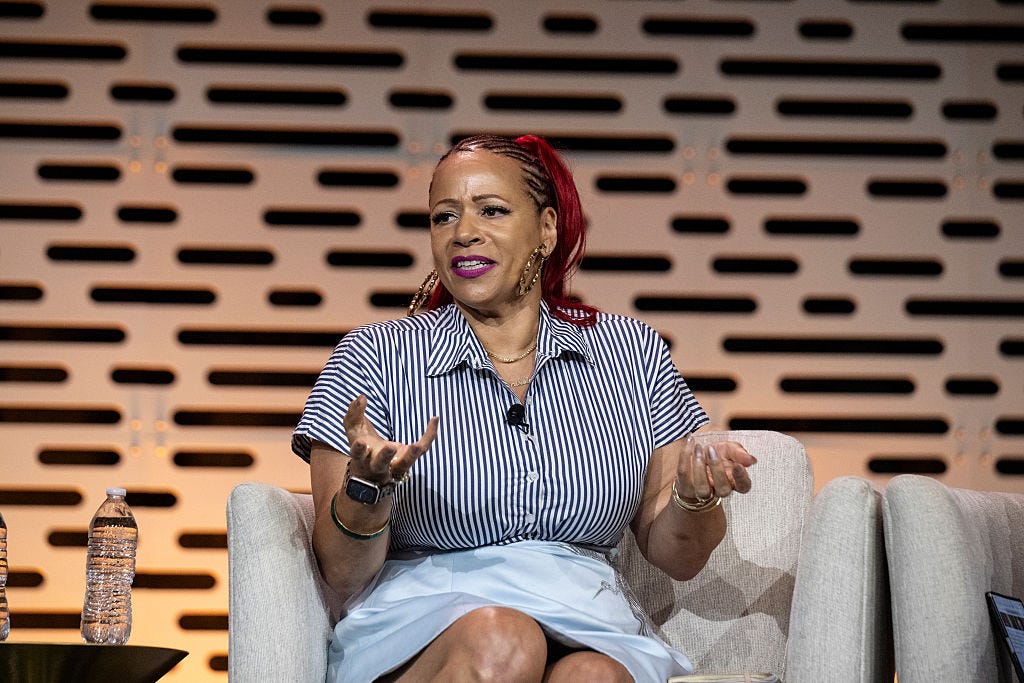
Acclaimed civil rights journalist Nikole Hannah-Jones has a remarkable essay in The New York Times grappling with her well-intentioned but ultimately harmful decision to send her daughter to underfunded inner-city New York City public schools. In scathing self-criticism, the lead editor of The 1619 Project admits her long-held insistence that wealthier families forgo their privilege to help the broader community hurt the person she held dearest: her daughter, Najya.
This is difficult for any parent to admit. Especially Nikole Hannah-Jones, who has built a career encouraging parents to make this tough choice along with other social justice initiatives. Her award-winning body of work focuses on racial injustice, specifically the under-education of African American children because of their race and socio-economic status. As is surprising to no American, poorer minority communities have worse public schools, while richer, whiter communities have better ones. Hannah-Jones and other egalitarians have long argued that wealthier families can combat this ‘educational apartheid’ (her term) by enrolling their children in the public schools, even if they could get into a better one. As the theory goes, the increased tax revenue, donations, and parental attention richer families provide will improve school quality and give students more opportunity—even if that improved performance is lower than what their individual child could receive elsewhere. One might call this selflessness. But as Hannah-Jones admits, it’s not. By sending her daughter into an underfunded school system, Hannah-Jones isn’t the one who sacrificed. Nahya was. And she had no say in the decision. The essay is profound in its analysis, self-criticism, and admission that it doesn't have all the answers. This is the antithesis of what usually appears in The Times opinion section, which is why this is the first JoeWrote article praising the paper that usually earns my scorn. The article is well worth your time, and you can read it for free here.
As expected, the essay centers on the Black experience in America and questions the moral responsibilities a wealthy Black family has to their larger community against their own daughter. Hannah-Jones grapples with the legacy of those who came before her, comparing her decision and that of previous Black parents who sent their children to desegregate schools, which was often a terrible experience for the child. I can’t offer any insights on that topic. Here are some people who can. What calls to me about Hannah-Jones’ admission is the underlying universal truth that no amount of individual choices can fix systemic failures. As Hannah-Jones writes:
“How could I spare myself the judgment I had meted out to others when they justified why they — despite believing in integration — sent their own children to schools that entrenched segregation? Across the country, I’d lectured about how educational inequality is systemic, but that this fact did not absolve each of us of our individual choices. And in the end, I could not even sustain the cause within my own family.”
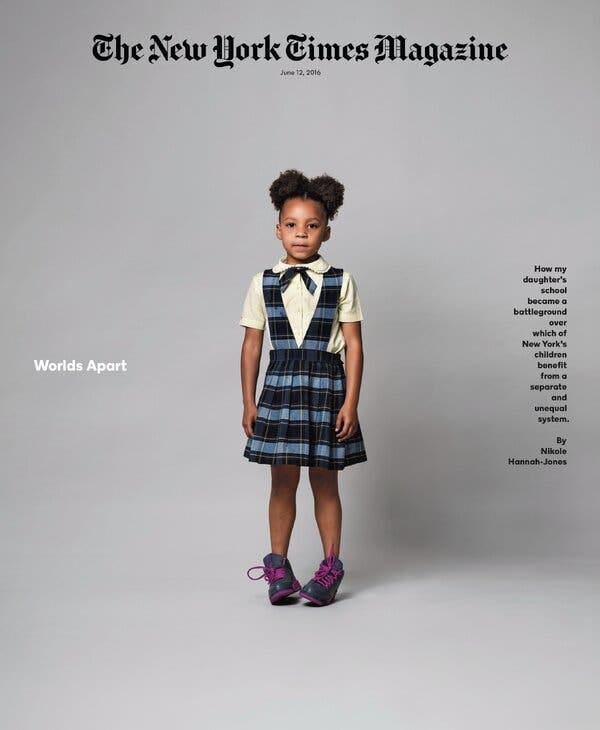
Hannah-Jones places the blame on her shoulders. Her critics do the same. National Review editor-in-chief Rich Lowry stopped ranting about Colin Kaepernick long enough to accuse The Times journalists of being “motivated by a savior complex.” As expected for a publication that explicitly argued for racial apartheid, Lowry claims Black schools are funded just fine, but it’s the ‘culture’ that holds them back. Megyn Kelly said Hannah-Jones “didn’t give a shit about her daughter,” and the New York Post accused her of “virtue signaling” at her daughter’s expense. The word “performative” flew around social media, casting the Hannah-Jones family as self-righteous social justice frauds who let their daughter suffer so they could morally posture at swanky New York cocktail parties. Even when we filter out the horrific racism, this critique misses what Hannah-Jones did for Najja, leaving the commentariat unable to grasp the author’s powerful reconciliation.
The Hannah-Jones family did not throw their child into a rough school and walk away like she was a fish in a catch-and-release pond. Both Nikole and her husband, Faraji, fought for Najya and the rest of her classmates at every opportunity. They advocated for their daughter through frequent meetings with principals and teachers, volunteered as lunchtime supervisors, and went above what their peers could offer with school donations and serving on the parent-teacher committee. Najya also received private tutoring, a benefit of her family’s wealth that her classmates likely couldn’t afford. In addition to wealth, Hannah-Jones’ prestige was another advantage lent to the cause. Given her career as a famous journalist covering the underdevelopment of Black education, Nahya’s teachers and administration certainly gave Nikole Hannah-Jones’ requests, concerns, and participation extra weight. While the author expresses justifiable frustration at multi-day response times from her daughter’s principal, her questions were likely answered first. And it still wasn’t enough to get her daughter the schooling experience every child needs and deserves.
Acknowledging Hannah-Jones’ notoriety and increased privilege over other parents isn’t a critique. Rather, it points out that Nahya had the best chance of any student to get a good education from an underserved school system. Despite hard work, intelligence, dedicated parents, a comfortable home life, private tutoring, and an award-winning racial justice reporter advocating for her, Nahya still couldn't overcome the failed results of a failing system. She struggled to pass statewide exams and other educational benchmarks, causing her great stress and hardship on top of everything else a teenage girl has to endure.
The lesson is clear: individual choices cannot overcome broken systems. Hannah-Jones recognizes this and identifies school choice as a source of the educational apartheid. Even as wealthier, typically white and Asian families move into historically Black and minority neighborhoods for lower rent, they are able to send their kids outside the corresponding school district through tests and sorting. There’s no explicitly racial component to the tests. But the result appears largely the same. White and Asian students get to attend better schools while Black children are stuck in the underperforming ones, even if they live in the same neighborhood. As a result, minority families experience the financial strains of gentrification, but none of the benefits of improved educational services. This further indicts systemic issues. Gentrification is not the result of individual choices by the gentrifiers, but multi-generational underfunding of poor neighborhoods and political deference to development and business interests. Hannah-Jones also criticizes teaching and administrative staff for absenteeism and lack of concern. I’m sure these professionals could make better choices. Yet again, I suspect America’s chronic underfunding of the teaching profession and relentless attacks on social services are to blame.
While systemic failures are not an excuse to shirk collective responsibility, Nikole Hannah-Jones’s raw account shows that no amount of virtuous decisions can overcome failing systems. The problems she identifies will continue until America grapples with its cultural aversion to the collective good, which stems from our adoration of capitalism and our refusal to finish Reconstruction. Still, I cannot commend Nikole Hannah-Jones’s genuineness and courage in admitting she was wrong and seeking future answers in the open. Integrity is a rare trait among the political class. And Nikole Hannah-Jones’s admission shows she has it, setting her apart from the chorus of “commentators” and elevating her to the status of a true intellectual—one who can set aside personal feelings to seek social solutions unhampered by self-interest.
While Nikole Hannah-Jones earns our praise, the systems she identifies should be the target of our wrath. As the late Michael Brooks said, “Be ruthless to systems and kind to individuals.” So ruthless we shall be.
If you appreciated this essay, please click the ❤️ to help it rise in Substack’s algorithm. Don’t forget to subscribe so future articles are delivered to your inbox. If you’re a returning JoeWrote reader, consider supporting my work with a premium subscription. For the cost of just one cup of coffee a month, you can help me keep creating content like this. Plus, you unlock everything JoeWrote has to offer.
Thanks in advance!
In Solidarity — Joe