

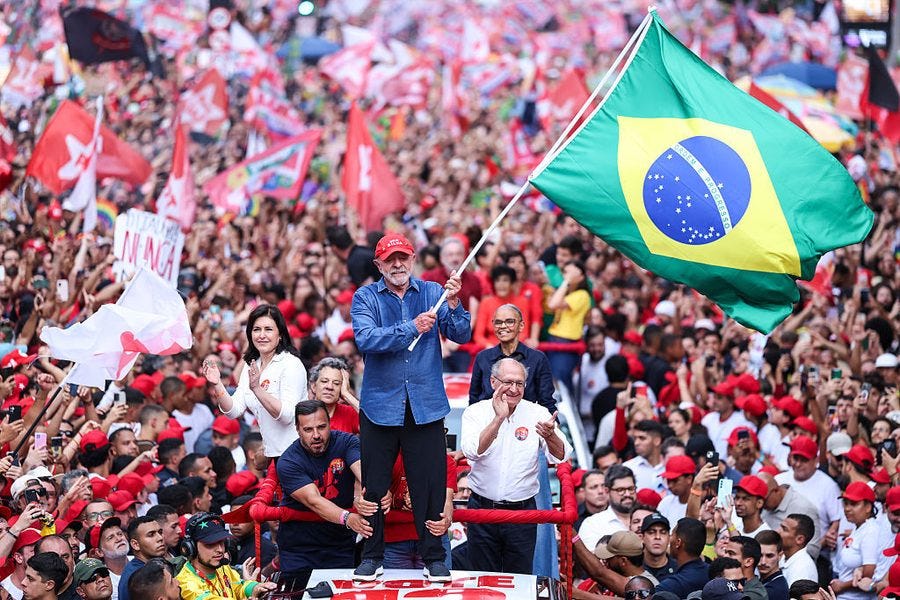
When Flavio Bolsonaro won the first round of the Brazilian presidential election, capitalists were overjoyed. Excited about the rightist’s corporate-friendly politics, investors poured money into the Brazilian real and stocks, expecting a conservative president. But after the Brazilian Workers’ Party (PT) rallied supporters and re-elected President Lula da Silva during the final round last week, investors reversed course. As soon as markets opened, the Brazilian real fell 11%, marking the currency’s worst day in over twenty-five years. The Brazilian Ibovespa stock index fell 10%, triggering the market’s circuit breaker and a mandatory 30-minute trading pause.
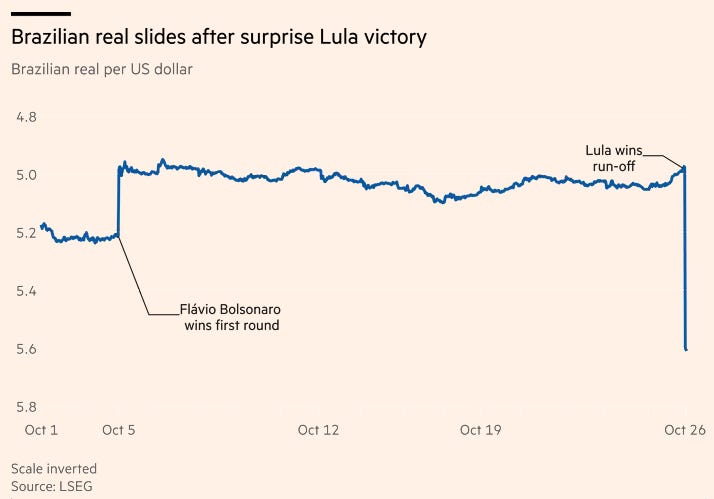
As the real drops, so does Brazilians’ purchasing power. Brazil’s imports (refined petroleum, cars, and computer chips) will become more expensive, while its exports (crude petroleum, soybeans, iron ore, coffee) will fall in value. The resulting inflation will raise the daily cost of living, and Brazilians will inevitably blame their leftist president—a narrative encouraged by the capitalist-friendly media, of course.
Unable to advance their interests through democratic elections, international capitalists are now holding the Brazilian economy hostage. By devaluing the currency below its pre-election rate, bankers in New York, Paris, and London are trying to weaken the Latin American social democratic project in favor of rightist movements sympathetic to their exploitative business interests. Now, capitalists are sending Lula an explicit message: follow their orders and cut social spending, or else.
When Bolsonaro won the first round, Morgan Stanley and JP Morgan upgraded Brazil’s stock rating to Overweight. This signaled to investors that values were likely to rise and that they should invest in Brazilian assets. But after Lula won, JPMorgan analysts stated the president would need to roll back spending programs, telling the Financial Times: “We believe delivering better fiscal results will require reforms to tackle rising pressures on mandatory expenditures.” The Eurasia Group echoed this sentiment, stating, “We don’t think a [spending cuts] package will be enough to appease markets.” Brazil’s largest mandatory expenses are social security and public-employee wages. Essentially, Wall Street is telling Lula’s administration that if he doesn’t drastically cut poverty-reduction programs, they’ll punish his constituents by raising prices. Of course, the poorest will be hit hardest by those price increases.
This is an example of capital flight—when owners think workers are gaining too much power, they withhold investment, throttling the economy. Though it is justified as a way to maximize profit, it has a clear punitive element. By sending an implicit threat to the social democratic administration, international capital warns Lula it will undercut him if he starts sounding like Fidel Castro. The Worker’s Party has faced this dilemma before. After Lula won the presidency in 2022, his victory speech mentioned strengthening multiple free trade blocs alongside BRICS, an investment strategy designed by Goldman Sachs.
“My friends,
In my international travels and in my meetings with leaders from many countries, what I hear most is that the world misses Brazil.
Longing for that sovereign Brazil, that spoke as an equal with the richest and most powerful countries. And that at the same time contributed to the development of the poorer countries.
The Brazil that supported the development of African countries, through cooperation, investment, and technology transfer.
Who worked for the integration of South America, Latin America and the Caribbean, who strengthened Mercosur, and helped create the G20, UNASUR, CELAC and BRICS.
Today we say to the world that Brazil is back. That Brazil is too big to be relegated to this sad role of the world’s pariah.”
The olive branch worked. The Biden Administration congratulated Lula on his victory, signaling to the world that the United States would not join Jair Bolsonaro’s ongoing coup. As a result, Lula was elected president, while Jair was convicted of treason and sent to the Lulag.
