

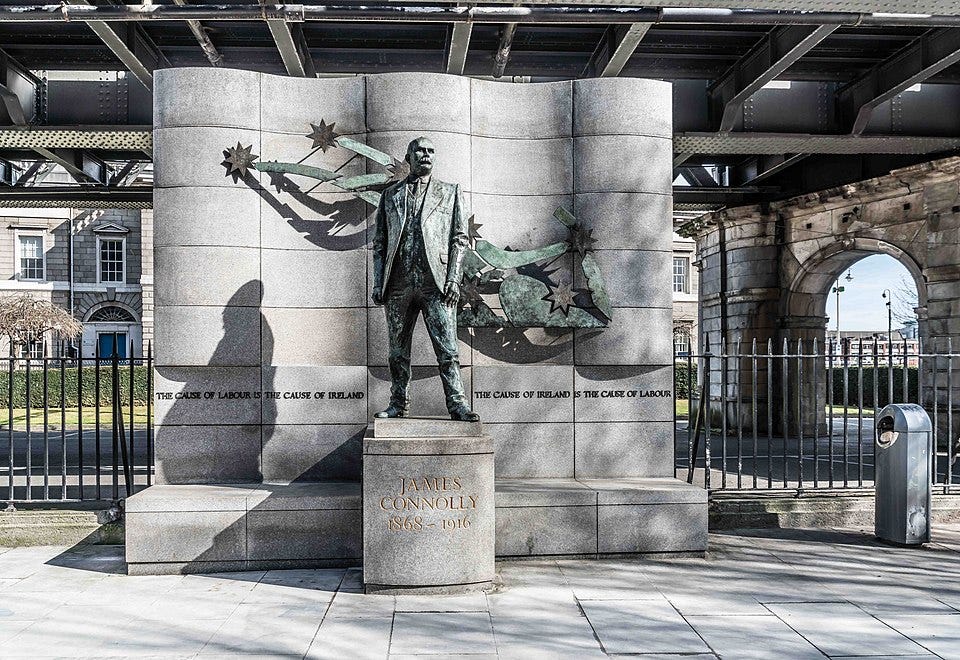
If I had to pick one person who most influenced my politics, it would undoubtedly be James Connolly, the socialist founder of the Republic of Ireland. One of the first full-time members of the Industrial Workers of the World, Connolly spent his life organizing, arguing, and fighting for the establishment of an independent Ireland and the international cause of socialism. He was the only socialist leader of the 1916 Easter Rising, for which the British imperialists executed him in a particularly barbaric fashion.

While he lived the life and died the death of a glorious left-wing revolutionary, spectacle is not why I’m fond of Connolly’s political theories. And though his demise was a story fit for film, the Irish socialist spent most of his time arguing for the slow, tedious work of building socialism through material organizing. Ironically, his role in armed revolution overshadows what I believe he would consider the core of his work, explaining how to organize workers to struggle for national liberation and international socialism. Connolly’s thoughts, which greatly influenced the Russian Revolution, are nicely summarized in the 1899 essay, The Economic Basis of Politics: The Stomach, Not The Brain.
“Examine the great revolutionary movements of history and you find that in all cases they sprang from unsatisfactory social conditions, and had their origin in a desire for material well being. In other words, the seat of progress and source of revolution is not in the brain, but in the stomach. The fact that this truth has hitherto been obscured, or even denied; that the pioneers of progress uniformly clothed their political demands in the most idealistic language and the most flowery phraseology; or that they constantly appealed for the support of ‘all unselfish and generous souls’, rather than to commonplace interests, only proves that we are all too prone to hide even from ourselves the real nature of our impelling desires, and, even when most stubbornly following our grossest instincts, to throw around our actions all the glamour of ‘spiritual cravings’, or ‘patriotic hopes’.”
In my opinion, this passage is the key to not just successful socialist politics, but all politics. Both in Connolly’s time and now, too many left-wingers expect socialism to be achieved through militant rhetoric, energetic protests, and extensive explanations of why socialism is superior to capitalism. But that is not what the working class responds to. As Connolly states, the only way to build strong, effective left-wing movements is to speak to the immediate, everyday problems of the working class: their wages, their healthcare, their rent costs, and their overall quality of life. Connolly validates this claim by pointing out that successful historical revolutions centered on material conditions, while failed revolutions made the mistake of appealing to people’s idealism or their better nature. He continues:
“The American Revolution was a revolt against the action of England in throttling the infant industries of America, and came to a head with a tax upon tea – all ‘base’ material reasons; the French Revolution was the revolt of an oppressed and famished people against outworn, medieval landlordism (feudalism) and the vexatious taxes upon industry imposed by a corrupt Court; the Irish Volunteer movement was, in its anti-English aspect, a revolt of the Irish manufacturing class against the restrictions put upon their trade by England, – “Free Trade, or else” was the motto they hung up on their cannon, and when that one point was gained all the ‘patriotic enthusiasm’ of the leaders vanished; Grattan termed the Volunteers, upon whose backs he had climbed to political eminence, ‘an armed rabble’, and the whole movement collapsed as suddenly as it had arisen – the economic basis being gone the patriotism was no longer evident.”
This is not to say that common people are selfish, lazy, or unmoved by high-minded ideas about national liberation, democracy, or justice. Rather, it is to point out the undeniable fact that any political movement needs widespread support, and the best way to gain it is to show how your ideology will solve the hardship facing the average person. In other words, politicians must speak to the aches of the stomach, not the theories of the brain.
Connolly’s historical evidence for prioritizing everyday issues is bolstered by modern examples. During the 2025 New York City Mayoral race, Zohran Mamdani ran on a clear platform of improving the lives of New Yorkers. He pledged to freeze the rent, make buses fast and free, and provide universal childcare. These specific policies helped voters envision how their lives would be better under a Mamdani administration than a Cuomo one. As a result, voters flocked to the democratic socialist, twice defeating disgraced former governor Andrew Cuomo, who ran on praising Israel and criticizing Mamdani for not condemning protest chants that most New Yorkers neither heard of nor cared about. I also believe the lack of focus on improving the American quality of life is why Kamala Harris lost to Donald Trump. Trump’s campaign platform of lowering housing and healthcare costs through draconian deportations was vile and nonsensical. But he did tie every one of his proposals back to addressing a real pain felt by American voters. Comparatively, the Kamala Harris campaign ran on ideas: her advisors pushed her towards ideological moderation, something that only exists in the minds of high-paid Washington insiders, and she implored voters to choose “country over party.” But voters weren’t thinking about “country” or “party.” They were thinking, “Which candidate will best help me?” So while Kamala Harris was appealing to the “patriotic enthusiasm” of “all unselfish and generous souls” with a symbolic rally at the Wisconsin birthplace of the GOP, Donald Trump was in Michigan, promising to bring down housing costs. Weeks later, Kamala Harris lost both Michigan and Wisconsin.
The same year he published The Stomach, Not The Brain, Connolly poked fun at the ridiculousness of ideas-centered politics in his satirization, Let Us Free Ireland!
Let us free Ireland! Never mind such base, carnal thoughts as concern work and wages, healthy homes, or lives unclouded by poverty.
Let us free Ireland! The rackrenting landlord; is he not also an Irishman, and wherefore should we hate him? Nay, let us not speak harshly of our brother – yea, even when he raises our rent.
Let us free Ireland! The profit-grinding capitalist, who robs us of three-fourths of the fruits of our labour, who sucks the very marrow of our bones when we are young, and then throws us out in the street, like a worn-out tool when we are grown prematurely old in his service, is he not an Irishman, and mayhap a patriot, and wherefore should we think harshly of him?
Let us free Ireland! “The land that bred and bore us.” And the landlord who makes us pay for permission to live upon it. Whoop it up for liberty!
“Let us free Ireland,” says the patriot who won’t touch Socialism. Let us all join together and cr-r-rush the br-r-rutal Saxon. Let us all join together, says he, all classes and creeds. And, says the town worker, after we have crushed the Saxon and freed Ireland, what will we do? Oh, then you can go back to your slums, same as before. Whoop it up for liberty!
And, says the agricultural workers, after we have freed Ireland, what then? Oh, then you can go scraping around for the landlord’s rent or the money-lenders’ interest same as before. Whoop it up for liberty!
After Ireland is free, says the patriot who won’t touch socialism, we will protect all classes, and if you won’t pay your rent you will be evicted same as now. But the evicting party, under command of the sheriff, will wear green uniforms and the Harp without the Crown, and the warrant turning you out on the roadside will be stamped with the arms of the Irish Republic. Now, isn’t that worth fighting for?
And when you cannot find employment, and, giving up the struggle of life in despair, enter the poorhouse, the band of the nearest regiment of the Irish army will escort you to the poorhouse door to the tune of St. Patrick’s Day. Oh! It will be nice to live in those days!
Much like a 19th-century Irish peasant with no reason to fight for a decolonized nation in which their lives would still suck, modern Americans see no reason to support a politician who won’t help them afford rent, groceries, or childcare. Connolly’s words were so profound that, with only a few tweaks, we can modernize them to fit our current situation perfectly.
“Let us save Democracy,” says the Democrat who won’t touch Socialism. Let us all join together and cr-r-rush the br-r-rutal Republicans. Let us all join together, says he, all classes and creeds. And, says the town worker, after we have crushed the Republicans and saved Democracy, what will we do? Oh, then you can go back to your slums, same as before. Whoop it up for Democracy!
Much like an independent and united Ireland in which rent is high and food scarce, what reason does the American worker have to believe in a politician’s appeals to “democracy” or “civility,” especially when those politicians have given the American worker neither democracy nor civility? They don’t. But when politicians heed Connolly’s advice and offer solutions laser-focused on making life easier, voters support them.
Unlike the Democratic establishment, which is at an all-time low in popularity, the Democratic Socialists of America have earned significant popular support for speaking to the immediate needs of the American working class. When Zohran Mamdani, Rashida Tlaib, or Melat Kiros runs for office, they don’t say, “Cast off the chains of capitalism, comrades! Glorious socialist utopia awaits!” Instead, they acknowledge the hardships of everyday life and offer practical solutions to make it better. Healthcare costs are too high, so we’re running to enact Medicare for All. Rent is too expensive. Let’s freeze it. Your boss pushes you around and makes you stay late? Here, we’ll help you organize a union. This strategy has made DSA incredibly successful, rising not just above other socialist parties but often over the Democratic establishment itself. Of the five most popular active politicians in the country, three are associated with DSA. It is also no coincidence that this strategy is working well to bring about the cause of Irish Unity. Sinn Féin, the revolutionary democratic socialist party leading the charge for a united Ireland, holds the most seats in Stormont, the parliament in the North of Ireland. This is quite an accomplishment for a party traditionally representing the Irish Catholic minority. Still, Sinn Féin is gaining popularity in the North and South of Ireland by running on housing, workers’ rights, and other working-class issues. While Connolly rightfully mocked the Irish nationalist capitalists who thought they could bring a free Ireland through appealing to patriotism alone, Sinn Féin is validating his theory that working to improve the living experience is the path to the high-minded and righteous goal of a united island free from colonial rule.
No matter what cause we struggle for, ruthless dedication to improving the material well-being of the average American is the path to it.
Happy Saint Patrick’s Day!
Tiocfaidh ár lá
If you enjoyed this article, please click the ❤️ to help my work rise in Substack’s algorithm. If you’re a first-time reader, remember to subscribe so future posts are delivered to your inbox. If you’re a returning reader, consider upgrading to a supporting subscription. For the cost of just one cup of coffee a month, you can support my work and unlock everything JoeWrote has to offer. Thanks in advance!
In Solidarity — Joe
My grandmother's maiden name was Emma Connolly, and she lived near Providence, Rhode Island. She had fiery red hair and refused to divorce her husband to get unemployment benefits for the family. Rhode Island was the last holdout to deny benefits to "intact" families.
They placed her children in foster care when she and her unemployed husband couldn't provide adequate food for them in the depths of the Great Depression. The following year, Rhode Island relented and began providing benefits to "intact" families, but it was too late for my mother and her four siblings. You have to be careful not to help lazy people, you know.
Every time my mother heard a car coming down the country road of the foster parents' home, she watched it go by, hoping it was her parents. She was only seven years old when taken. Her parents never afforded a car. Mother was always proud that her parents refused to sign away their rights to their children.
If Kamala had emphatically promoted Medicare for All, she would have won, even though she abandoned the people of Gaza, a tragedy of catastrophic proportions.
By the way, I recently heard about a single mother I've known for over twenty years who has worked as a waitress the entire time and had her son put in foster care because he had bad teeth that she couldn't afford to fix. The State will say there is a way to get free dental care if you can figure it out. They're still blaming victims for child negligence to cover for a failing economy.
Thank you for putting this piece together, Joe. I am especially relating to what Connolly said in Let Us Free Ireland!