

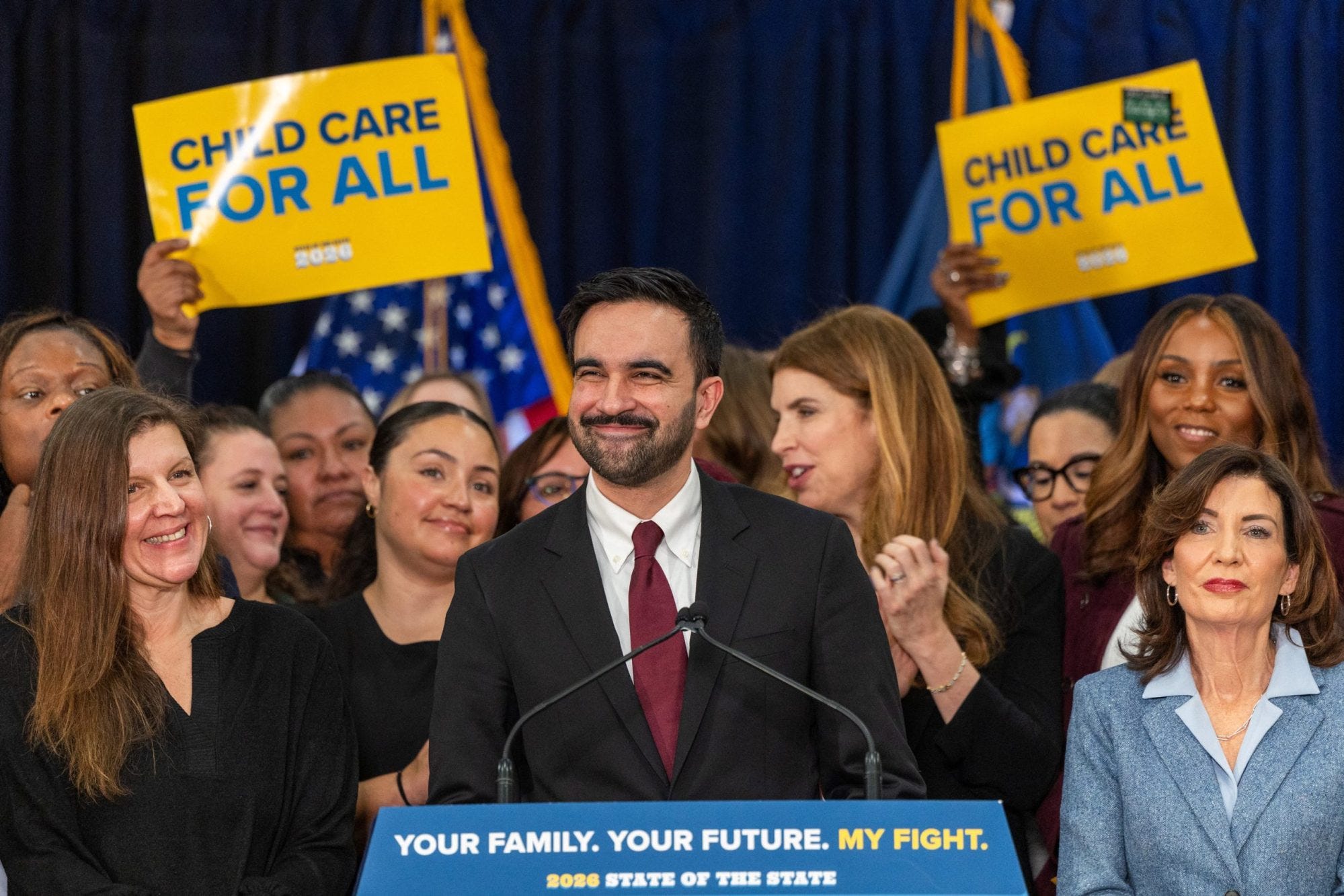
Let’s be honest. The media has nothing on Zohran Mamdani. Ever since the socialist achieved double-digit support in last year’s Democratic mayoral primary, establishment media have been trying to sink him. From the New York Post scandalizing his relocation of collegiate furniture to The New York Times calling his primary victory a “spiritual Kristelnacht,” there’s been a concerted effort to drive Mamdani out of political relevancy. The campaign continued even after Mamdani assumed office. A few weeks back, Jake Tapper used primetime to criticize what Ms. Mamdani posted on Twitter when she was fifteen, and reporters tried to force Mamdani into a negative press cycle by imploring him to ban snowball fights.
As each attack falters and Mamdani’s mayoralship looks better and better, the press is growing more desperate to find something to hold on to. Which is how we arrived at this latest New York Times article that dares to ask: Is Mayor Mamdani too successful? Are too many children being cared for?
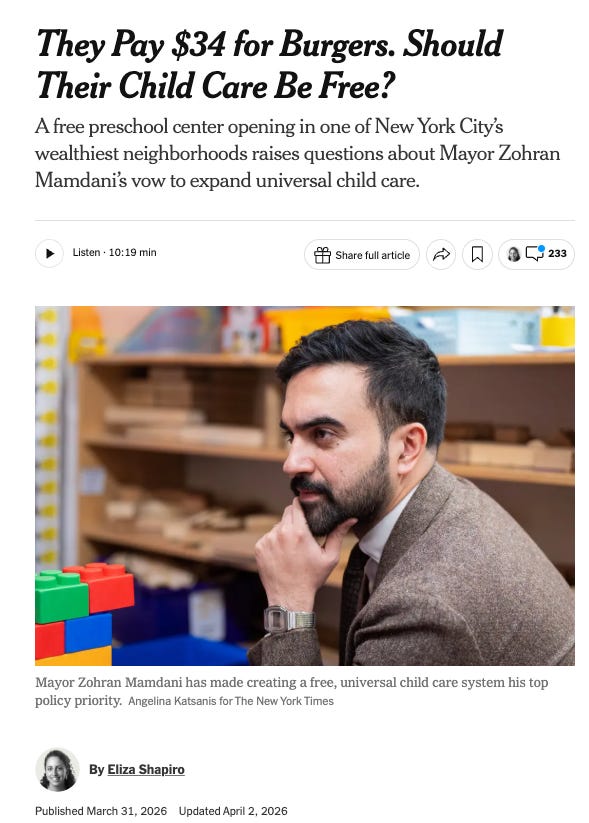
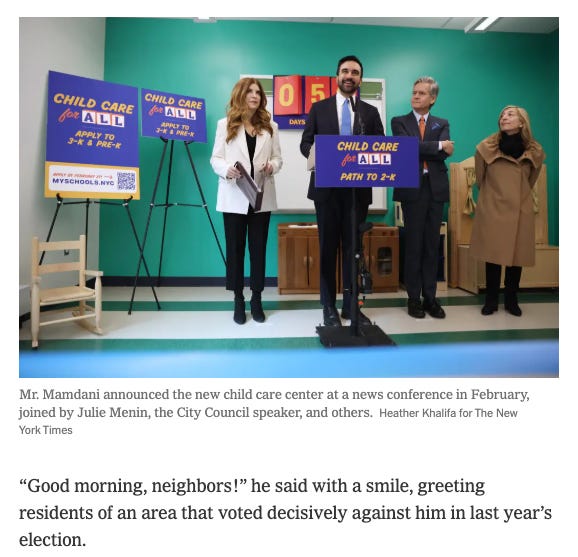
As the headline indicates, this article attacks Zohran Mamdani’s universal preschool program from a pseudo-populist position, implying it’s a benefit to the rich at a cost to the poor. The author, Eliza Shapiro, focuses on a planned public childcare center opening on the Upper East Side, one of New York’s richest neighborhoods, portraying it as if Mamdani is betraying his progressive values. Shapiro writes:
“The notion that Mr. Mamdani — a democratic socialist elected on a tax-the-rich platform — would end up being the mayor to answer the Upper East Side’s pleas for more child care illuminates a fact about his administration that neither the mayor nor his critics seem eager to acknowledge.
If he is able to deliver on his promise to make New York City more affordable for struggling New Yorkers by adding a slew of new, free services available to all, he may end up making it easier for the wealthy to live here, too.
It’s not exactly the stuff of populist campaign slogans.”
This is such a petty argument to make. Mamdani did not campaign on driving all the rich people out of New York City so poor people could move into their apartments and hire their nannies. He ran on making NYC more affordable, which free pre-school does by putting downward price pressure on private childcare options. Shapiro is intentionally trying to sow division between the mayor and his progressive base because that’s the only thing the media has left. They’ve called him a Jew-hater, godless communist, and acted like he was going to turn New York City into the lawless anarchy of The Dark Knight Rises by locking all the cops in the sewer. Now, all they’ve got is the same pathetic excuse as the ultra-left: Socialism betrayed???
Also, Shapiro's claim that Mamdani isn’t “eager to acknowledge” opening a pre-k center on the Upper East Side is a lie, given that Shapiro’s article discusses the many press conferences Mamdani held to draw attention to this specific center.
This fake populism is a common attack from centrist politicians and media figures. During the 2020 primary season, Hillary Clinton, Pete Buttigieg, and Amy Kloubachar attacked Bernie Sanders’ plan for tuition-free college with the same pseudo-left language, claiming it would be a gift to rich people.
“I’m skeptical of spending [tax revenue on millionaires and billonaires.” — Pete Buttigieg, 2019
Much like the establishment’s attacks on Sanders, this article is written in extraordinary bad faith. That said, it’s worth addressing why social programs should be universal. (Spoiler alert: universal programs help the poor and means-tested programs hurt them.)
Define “Rich”
The premise of Eliza Shapiro’s article is this: the Upper East Side (UES) is a wealthy neighborhood, so the mayor shouldn’t open a publicly-funded preschool there. This might be a good argument if everyone in this neighborhood could afford a private nanny, but that’s not the case. The median household income on the Upper East Side is approximately $165,000, more than double the New York City average of $79,000. That’s a lot of money, but so is the cost of childcare.
