

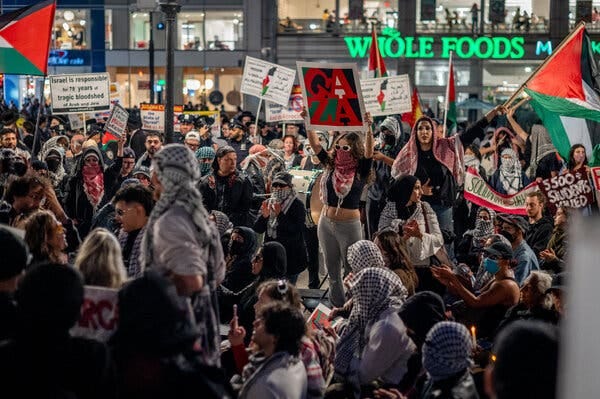
Protesting is one of the most organic political actions. Since the dawn of civilization, whenever people are dissatisfied with their rulers, they air their grievances loudly and publicly. For as long as there have been capitals and castles, there have been angry crowds outside them, jeering the powerful within.
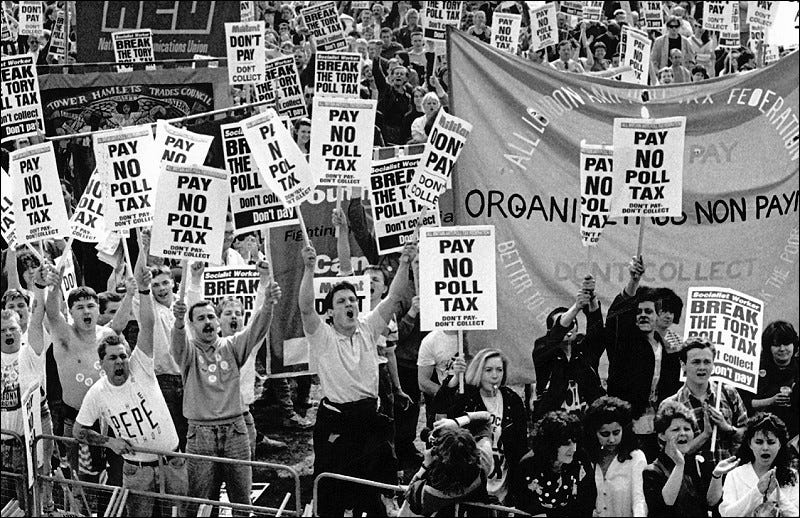
But not all protests are equal. Some build vibrant, powerful movements that achieve their goals by codifying grassroots discomfort into law. The 1955 Montgomery Bus Boycott lasted 381 days, building public pressure that eventually led the Alabama district court to rule racial segregation unlawful. In 1987, the June Movement brought down South Korea’s military dictatorship, and three years later British citizens won the repeal of a poll tax through sustained protests and political action.
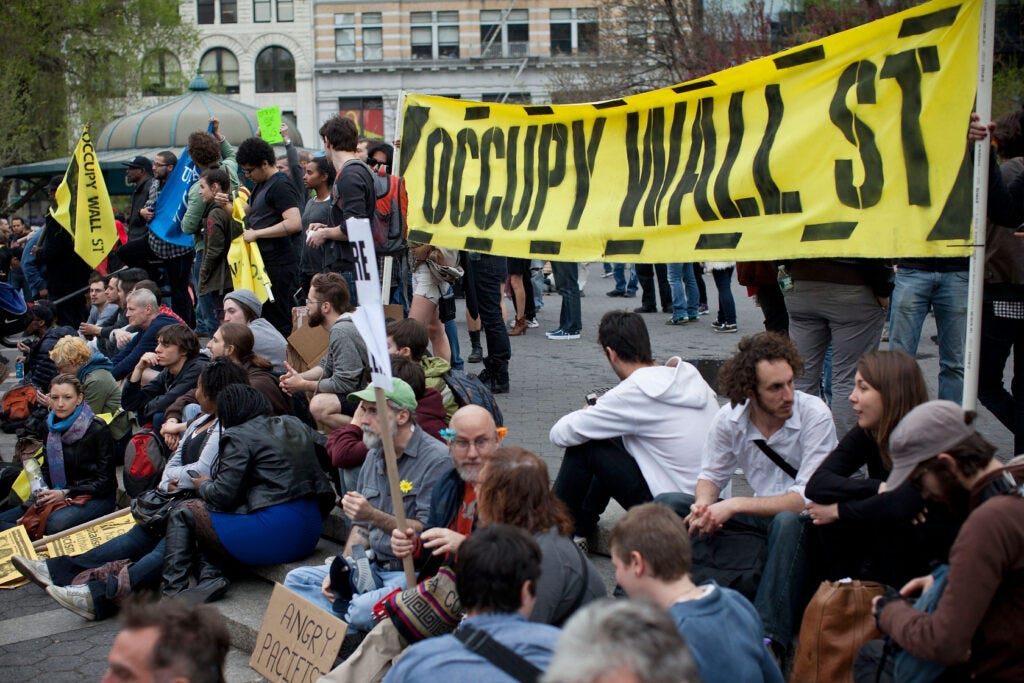
Comparatively, less-organized protest movements struggle to find success. Occupy Wall Street served as a training camp for activists who propelled Bernie Sanders’ 2016 campaign and the rebirth of the socialist left. But Occupy’s vague, idealistic demands limited the movement and failed to attract mass support necessary to win concessions. “Outlaw all credit reporting agencies” and “open the borders” were too strong an ask for what was ultimately the occupation of a city park. Wall Street tycoons didn’t appreciate angry protesters in their financial district. But the movement never dissatisfied or threatened capital enough to motivate bankers to call their corporate politicians and tell them to open the Southern border. And even if they did, no single law can achieve the open borders imagined in leftist utopia. The Occupy protestors weren’t wrong to fight for a more equal society. But their calls for social revolution greatly overestimated their power and isolated them from the masses, yielding few material gains.
That is why concrete, achievable demands are crucial to any mass movement—especially protests, given the decentralized nature and unpredictable conditions of street action. Without clear objectives, unity of purpose, and strict message discipline, protests risk dissolving into chaos that drains energy, fragments coalitions, and opens the door for counter-revolutionary movements to seize power.
Recent protests in New York City, France, and India show that organization is key to a successful protest movement.
New York City
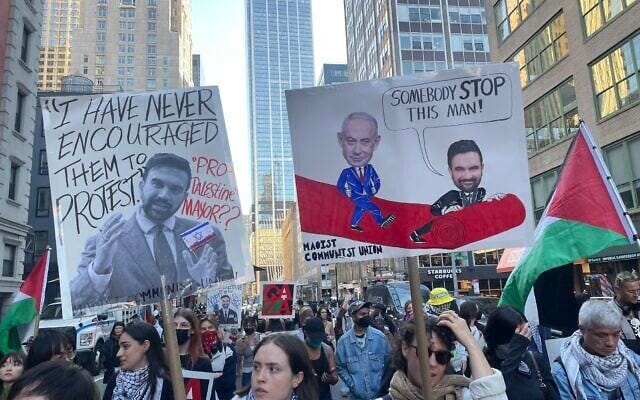
The first protest we’ll examine took place in New York City on October 7th outside City Hall. Organized by the Palestinian liberation group Within Our Lifetime (WOL) and endorsed by dozens of student and liberatory organizations, the call to action accused Mayor Zohran Mamdani of “capitulating to Zionist pressure” and other transgressions related to his dealings with the city’s powerful Zionist political establishment:
In New York City, Mayor Zohran Mamdani campaigned on promises to the Palestine movement. He has betrayed his own alleged values, failing to make those promises a reality. Instead, he has repeatedly capitulated to zionist pressure: Criminalizing protests against the sale of stolen Palestinian land in New York City through the passage of the NYC Council Bill Intro 1-B; allowing the NYPD to surveil, arrest, and violently suppress protests against these illegal land sales; and most recently, pledging $26 million tax dollars to the “Strategy to Combat Anti-Semitism“ which will provide funding for zionist propagandist groups such as JCRC-NY; and security infrastructure for zionist synagogues which host illegal real estate sales of stolen Palestinian land to expand settlements.
The Mayor’s claim of solidarity with the Palestinian people is meaningless when it is followed by no action and capitulation to zionist pressure.
The problem here is that the organizers listed grievances, but no demands. Without concrete steps to address these grievances, neither the protestors nor the protested know exactly what the group wants. For example, WOL accused the mayor of “criminalizing protests against the sale of stolen Palestinian land in New York City through the passage of the NYC Council Bill Intro 1-B.” This refers to the infamous law that established a protest “buffer zone” around “places of worship,” an implicit protection for synagogues that host real estate events selling stolen Palestinian land. But it’s wrong to say Mamdani “criminalized” protest, or even focus on him if a movement aims to end buffer zones. The New York City Council passed Intro 1-B with a veto-proof 44-5 majority. Mamdani returned the bill unsigned to signal his disapproval. The Council also passed a similar bill establishing a buffer zone in schools, 30-19, which Mamdani vetoed. Because the action focused on vague complaints rather than specific demands, it didn’t apply pressure to the right outlet. (The same is true of a later demand that Mamdani abolish the City University Board of Trustees, which he can’t do because New York State law established the Board.) As a result, the buffer law was no closer to being repealed than it was before the action. If anything, the protest’s disorganized chants and unsettling tactics drove away crucial allies, furthering them from their goals.
On the morning of October 7th, hours before the protest began, Politico ran a story about how The Legal Aid Society, the NYCLU, and other NYC-based criminal justice reform advocates urged the mayor to live up to his campaign promises. Specifically, they wanted the administration to abolish the NYPD’s violent Strategic Response Group and the gang database. One official pressuring the administration was DSA City Council member Tiffany Cabán, who urged City Hall to show movement on its pledged police reforms. As Politico wrote:
Council Member and fellow DSA-member Tiffany Cabán said the mayor has taken a big first step with his new public safety department and has done much to address affordability through other initiatives like an expansion of childcare — which she said are crucial to boosting safety by making New Yorkers less likely to commit crimes in the first place. But she argued falling back onto failed policing practices undercuts that progress, and that a major shakeup in NYPD operations is necessary. And she’s confident she’s not alone.
“It’s nine months in. You give a certain level of grace for coming in and having to do a whole lot in a short amount of time,” Cabán said. “But we’re getting to a point where I think you’ll see outside organizations, advocacy groups and directly impacted folks knocking at the administration’s door and saying: Hey, time is kinda up. We need to see some more movement.”
Hours later, the protest began outside of City Hall and accused Mamdani of genocide. Chants included “700,000 dead. Mamdani, your hands are red!” and “We don’t care about where you’re from. You cannot talk about being Muslim anymore. You cannot weaponize being brown anymore. Identity politics can only get you so far.” Later, the WOL protest moved and disrupted a vigil eulogizing fallen Israeli and Palestinian civilians that Mamdani was attending.
The very next day, Cabán distanced herself from the vigil protest, saying she was “heartbroken to see last night’s disruption of the vigil honoring the lives of the Palestinians and Israelis killed over the last three years.” Cabán was one of five city councilors who voted against the buffer zone bill, which the protest organizers listed as a grievance. If your protest alienates politicians already on your side, it’s unlikely to entice other councilors to work with you to vote to repeal the law. Now, two forces advocating for something as reasonable as disbandment of a violent police unit and an end to state censorship have been separated. Cabán wasn’t the only one frustrated with the disruption. In a recent interview with Drop Site News, Palestinian civil rights activist Mahmoud Khalil criticized calling Mamdani a “genocide enabler,” saying it cheapened the word and disrupted the higher aim of the Palestine solidarity movement. Both Khalil and United Nations Special Rapporteur on Palestine Francesca Albanese encouraged protestors to move away from “purity politics” and “internal struggles” and focus on the immediate priority of stopping weapons shipments to Israel.
International Efforts
To see how protests can be more effective, we look to two international examples: India and France.
In India, the youth-led Cockroach Janta Party (CJP) has brought millions into the streets to rally for democracy, education, and economic reform. The CJP’s five demands are broadly appealing and list specific ways for the government to meet them:
Jobs & Accountability: “A National Employment Guarantee for graduates — modeled on MGNREGA but designed for educated youth. Minimum stipend for graduates who cannot find employment within 6 months of graduation.”
Education Reform: “Resignation of the Education Minister — the minister in charge when a national exam is compromised must take responsibility, not deflect it.”
Press Freedom: “Independent media tribunal — a body to investigate government interference in editorial independence, with the power to impose consequences.”
Judicial Dignity: “Judicial accountability mechanism — a transparent, citizen-accessible system to file complaints about judicial conduct, with mandatory review timelines and public outcomes.”
Radical Transparency: “Full public audit of PM CARES Fund — conducted by the CAG and published in full, showing every rupee collected and every rupee spent, with beneficiary details and project outcomes.”
When the CJP and its allies marched on the Indian Parliament, they did so with slogans that attracted a broader coalition and inspired others to join. As a result, the government looked outside its window and saw an organized, energized constituency united by a common cause. Feeling the heat, the Modi government relented and agreed to partial demands. As the CJP website shows, the party took particular pride in ousting the Education Minister.
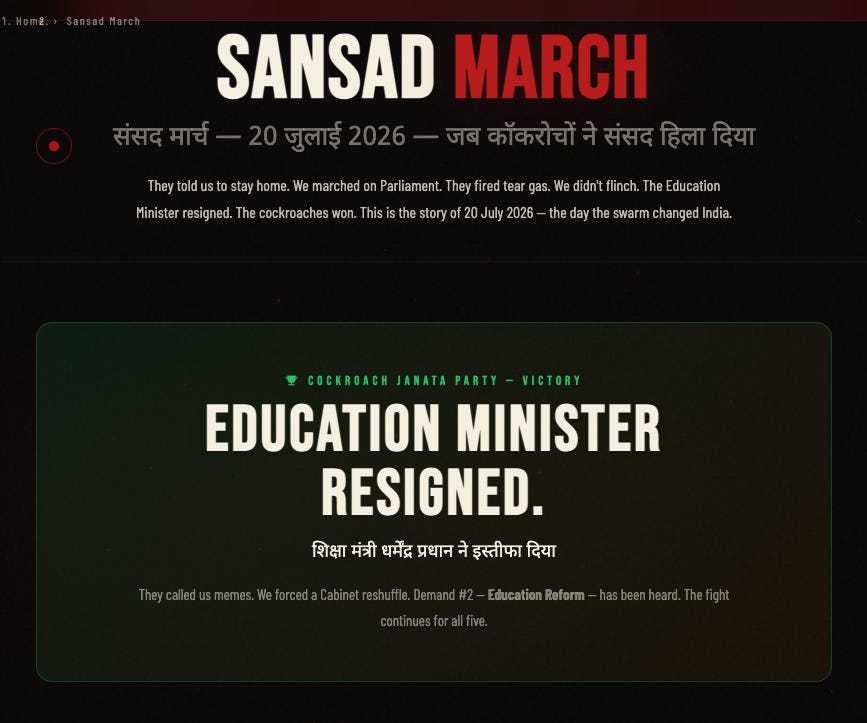
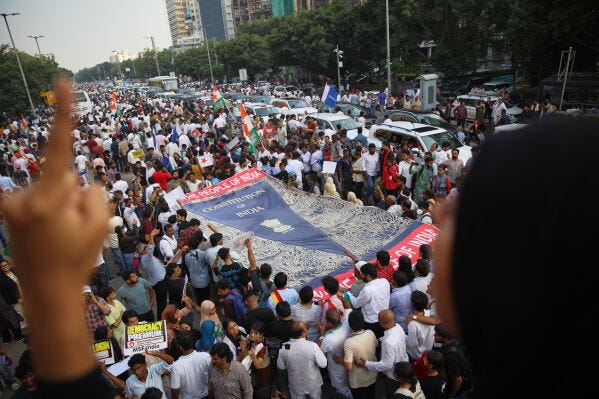
Emboldened, the protests grew, and the Modi government cracked down. When CJP founder Abhijeet Dipke and his closest advisors were arrested, the cockroaches (their term) regrouped and demanded the leaders’ freedom. A court quickly released Dipke and company, even while the police detained over 15,000 protestors. Now, the leaders are back on the street, leading the protest toward its next goals: freeing all prisoners and securing the resignation of Chief Election Commissioner Gyanesh Kumar. Their slogans are broadly appealing (“Final Call to Save Democracy”), and an official spokesperson issues statements, giving the CJP clarity of purpose and the power to continue the fight, even in the face of brutal government repression.
We see similar strategies and results in France. Last month, teachers at Saint-Exupery High School in a suburb outside Paris went on strike demanding full staffing and an end to teacher shortages. Students joined in, protesting austerity measures that have led to run-down schools, missing teachers, and what they describe as inadequate education. Experiencing the same issues as Saint-Exupéry, students and labor unions from other school districts began their own protests, which coalesced in Paris around ten clear demands. They didn’t just say “end teacher shortages” and “support students,” but listed specific metrics for the government to meet, including student-to-professional ratios—“One nurse per five hundred students”— an increase in education accessibility—“250,000 additional places in higher education starting next academic year”—and material improvements to living conditions—“Increase student grants by €200 per month, distribute them over twelve months, and allow 300,000 additional students to access the grant system.” By articulating what they wanted and the steps ministers should take to satisfy them, the protestors set a clear threshold for the movement to know when it had won.
Feeling the pressure, the French government announced it would deploy 3,000 substitute teachers to fill vacancies at underfunded high schools nationwide. Students at Saint-Exupery High School reported that their issues were fixed locally, and French Prime Minister Sébastien Lecornu pledged to increase education funding in the upcoming budget. Students plan more protests on Tuesday, October 13th, to keep up the pressure and make sure the promise becomes reality.
Lessons Learned
While many demands of the CJP and French student union remain unfulfilled, there’s no denying their movements have been incredibly successful. By clearly stating what they are fighting for, attracting allies, and practicing message discipline, they have built mass movements that threaten state power and win concessions. They didn’t just disrupt; they built pressure and applied it to specific targets. Pressure is not the same thing as noise. Noise can be ignored or brushed off. Pressure cannot. By building a large coalition willing to march in the street and endure brutal oppression, mass protests show politicians and bureaucrats exactly what the crowd wants them to do — pass a law, fire a minister, etc. If the demands are ignored, then everyone in the crowd will be pissed. They might vote against you, reject your party, or even bring society to a halt by occupying major metro and commercial areas. This is pressure. But it works only when the protest is a large coalition pressing for specific requests, not a small, alienating contingent that scares off would-be allies and is easily dismissed by politicians and misrepresented by the media.
Fortunately, many in New York City are adhering to protest best practices. Following an ICE shooting last Friday and the NYPD’s harsh treatment of anti-ICE protestors, calls to abolish ICE and the NYPD’s Strategic Response Group, as well as removing police commissioner Jessica Tisch, grew over the weekend. In response, New York City DSA released clear demands: The federal government must abolish ICE, Tisch must disband the SRG and end NYPD assistance to ICE or be fired; the New York City Council should pass the CURB Act to end all SRG abusive tactics, and the state assembly must pass the New York For All and Safe Access to Care acts to prevent ICE from entering hospitals.
The NYCLU was more specific, calling out City Council Public Safety Chair Oswald Feliz and Speaker Julie Menin for blocking the CURB Act. In addition to urging New Yorkers to call these councilors, the NYCLU is hosting a rally outside Feliz’s office on Tuesday morning. Hoping to draw media attention and supporters, the rally aims to show Councilor Feliz that his constituents want the CURB Act passed. By building power, uniting behind an achievable demand, and focusing on the specific points and people in the political process blocking the goal, this rally is likely to bolster the movement for necessary police reform.
That said, this doesn't mean Within Our Lifetime or any of the protestors who showed up on October 7th were wrong. They’re aghast at the slaughter of Palestine and rightfully seek to stop it. But to achieve our shared goals, we’ll need to channel that energy into effective, disciplined grassroots movements that can win. If the protest best practices of strict message discipline, clear goals, and a mass appeal remain absent, then the movements for safe policing and a free Palestine will be powerless, and the oppression will continue unchallenged.
For more on the success, failures, strategies, and tactics of progressive movements, I suggest Vincent Bevins’s excellent book If We Burn.
If you appreciated this essay, please click the ❤️ to help it rise in Substack’s algorithm. Don’t forget to subscribe so future articles are delivered to your inbox. If you’re a returning JoeWrote reader, consider supporting my work with a premium subscription. For the cost of just one cup of coffee a month, you can help me keep creating content like this. Plus, you unlock everything JoeWrote has to offer.
Thanks in advance!
In Solidarity — Joe
I don't think I've seen a protest accomplish anything in my entire lifetime in the US. The 60s get mythologized, but that was more than fifty years ago.
We have learned that organization gets you targeted and infiltrated, like the ICE protestors in Minneapolis. We've learned that you can go to jail for 30 years for moving boxes of zines if someone you organized with gets arrested doing something you aren't a part of. We've learned that we are under surveillance at almost all times.
We've also seen Luigi move the needle, and school shootings pretty much every week.
So. Honestly, I think lone wolves are going to matter and protests aren't, at least until we see a big national security reform.
I don't think
The big problem here is that there is a natural limit on the number of morons and mentally unbalanced individuals in any given population that will buy the anti-Palestinian pro-Hamas antizionist line, or the anti-Western pro-Communist line.