

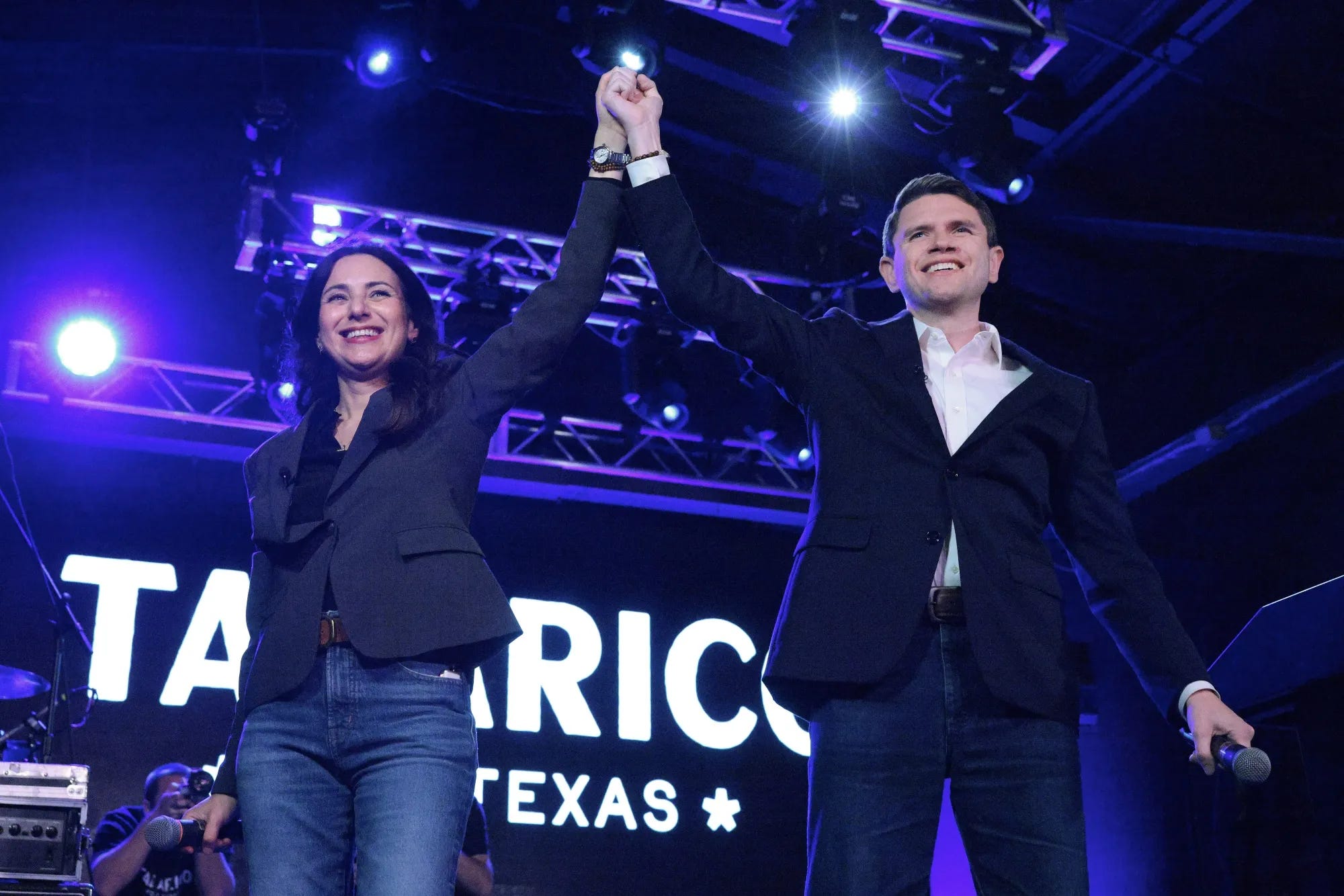
Last fall, I argued the Democrats’ 2024 campaign moved too far right on economic issues, costing them votes and the election. To fix the mistake, I encouraged the Democrats to embrace economic populism and run on a higher minimum wage, universal social programs, and other class-based economic policies to win seats nationwide. As I wrote at the time:
“Going forward, bold, pro-worker economic policies are the key to re-expanding the tent that the establishment shrank in 2024.” — Centrists Shrank the Democratic Tent. Only the Left Can Expand It.
Last week, the Democrats won a historic landslide victory with a ‘big tent’ coalition. From Maine to Kansas to California, that big tent was upheld by the sturdy tent pole of left-wing economic populism. The victory speeches of nearly every newly elected governor and senator centered on class-first economic messages, railing against billionaires, corporations, and special interests.
“But the billionaires who own the social media algorithms, who own the cable news networks, who own the politicians fighting on our screens, they want us at each other’s throats... They want us looking left and right at each other instead of looking up at them.” — James Talarico, Texas Senator-elect
“It is time for a Statehouse that puts Ohioans first, not special interests and corporations and billionaires. This is a moment for courage.” — Amy Acton, Ohio Governor-elect
“[A South Carolina] where decisions about our communities are made by the people who live in our communities, not the billionaires or data center companies in Washington, D.C.” — Dr. Annie Andrews, South Carolina Senator-elect
“Tonight’s results are a wake-up call for corporate special interests and billionaires who have been rigging the economy, for the cowards in Congress who have enabled healthcare cuts, tariffs and war.” — Chris Pappas, New Hampshire Senator-elect
“We knew that the Washington, D.C., insiders and the richest Americans were getting unimaginable wealth at our expense.” — Roy Cooper, North Carolina Senator-elect
“Corporations, billionaires tried to buy this election. You know that. But As it turns out, as it turns out, there are a whole lot more of us than there are of them.” — Sherrod Brown, Ohio Senator-elect
“Tonight, Texas, we answered — and we didn’t whisper. We answered loud enough for every billionaire, every lobbyist, and every corrupt politician in Austin to hear: Texas belongs to us.” — Gina Hinojosa, Texas Governor-elect
“We need to embrace that thing about us that has always made us great, the will to be more perfect. And right now that means taking on the corporations and the billionaires, special interests who’ve rigged the system against us for far too long.” — Abdul El-Sayed, Michigan Senator-elect
This is a different tune than the one Democrats have been singing. With a few exceptions, Democrats have been running on neoliberalism, tax cuts, and business-friendly regulations for my entire lifetime. But after a decade of intra-party guerrilla warfare led by the Bernie Sandersistas, Democratic voters elected progressives and socialists who did more than just pay lip service to the plight of the working class. Come January, candidates supported by the Democratic Socialists of America will hold eight House seats and run two of America’s most iconic cities, Los Angeles and New York, as well as the national capital. Dozens of other DSA candidates were elected to local and state offices across the country. And this doesn’t even include progressive candidates run by the Sunrise Movement, the Working Families Party, Justice Democrats, and other leftist groups.
The left's influence over the Democratic Party has been growing since 2016. But this year it reached critical mass and shifted the party left on economics. A year ago, the Democratic establishment fretted that Zohran Mamdani’s “extremist policies” (free bus fare) were an albatross around the party’s neck. The Argument, a liberal publication funded by billionaires Dustin Moskowitz and John Arnold boldly stated, “Mamdani’s spectacular unpopularity suggests that his ideas are not to be used as a national party template for a larger, more general audience.”
Well, the opposite happened.
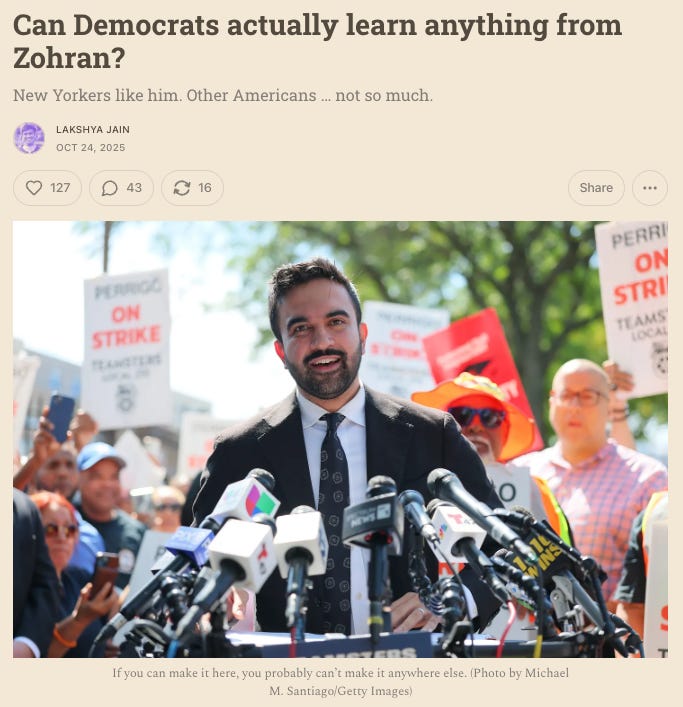
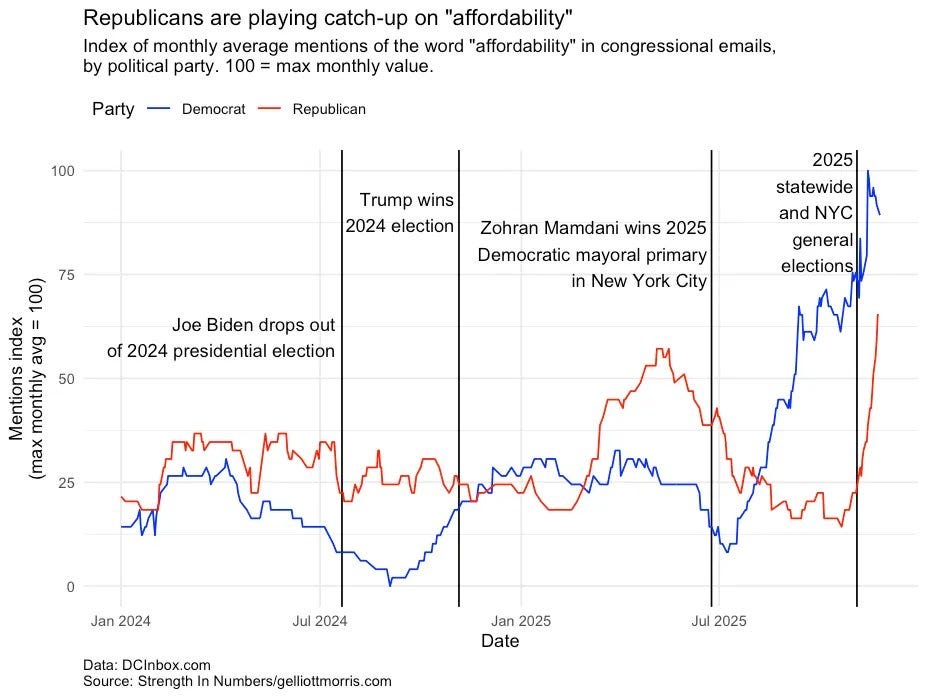
As the most popular elected Democrat in the country, Mamdani’s affordability agenda and populist rhetoric became the national party template that drove the Republican rout. As G. Elliott Morris observed last year, Democrats and Republicans began running on “affordability” after Zohran Mamdani popularized the term during his campaign. Mamdani’s message was so present in midterm rhetoric that Business Insider, no friend of the socialist left, summarized the results as “The United States of Mamdani,” saying “Mamdani's program has offered a road map back to relevance for Democrats.”
No one denies that affordability and economic populism, which combines anti-corruption rhetoric, anti-elite sentiment, and pro-worker policies, was the winning message. Searchlight Institute founder Adam Jentleson, who strongly discouraged the populist rhetoric of Bernie Sanders’ Fighting Oligarchy tour, dropped his opposition and claimed the Vermont Senator’s mantle. In a recent interview with Ezra Klein, the former John Fetterman chief of staff said, “From the moderate wing, there’s been an embrace of economic populism on a scale that you haven’t seen before.” This is true. However, many establishment and conservative Democrats are shamelessly trying to retcon their past positions to pretend they were economic populists all along. Unfortunately for these podcasters and bloggers, Google exists.
