

The Democratic Socialists of America’s increasing political power has triggered an establishment freakout. Marco Rubio is openly planning to suppress DSA and other left-wing groups with a return to blacklists and McCarthyism, Fox News won’t shut up about us, and The Atlantic has run not one, not two, not three anti-DSA articles already this month. Not to be outdone, Rupert Murdoch’s The Wall Street Journal took a shot at American democratic socialists with an article and accompanying TikTok video about how Scandinavia isn’t fully socialist. Which, yeah. Any socialist could’ve told you that.
Before you watch the video below, you must know this is Mary Julia Koch, daughter of the late David Koch, libertarian billionaire and funder of far-right projects. Mary’s mother, Julia, is one of the richest women in the world. It’s important to understand that we are dealing with a Faildaughter. We’re all well aware of Failsons — Eric Trump, Hunter Biden, Kendall Roy, and other unimpressive children of the capitalist elite whose luxurious upbringing left them too emotionally and professionally stunted to be productive members of society, never mind live up to their parents’ legacy. Failsons are hilarious because their last name traps them in a prison impossible to escape. Wealth and comfort protected them from the world, and as a result, they’re supposed to lead it. Once appointed to high-profile positions, Failsons inevitably bumble around and mess everything up. But it’s the 21st century, and feminist activists fought hard to ensure Faildaughters have just as much right to make a fool of themselves in front of the world as their equally stupid brothers. (#ally) So, that’s how Mary here ended up as an associate opinion editor at The Wall Street Journal just two years out of college. But maybe I’m being too harsh. Let’s hear her out.
Yeah. That went about as well for Mary as I thought it would.
Instead of engaging with the merits of Scandinavian socialism, The Wall Street Journal decided to let David Koch’s daughter play journalist with a two-minute lecture on how DSA-associated politicians are foolishly looking to Northern Europe as a model to replicate. In the accompanying article, Mary lists DSA-elected officials who have mentioned Norway and Finland, Denmark, and Iceland as examples of socialist success, then tries to explain why they’re wrong:
“The issue is that Nordic countries aren’t socialist. Their economies are highly competitive free markets, built on private ownership and global trade. Finland, Denmark, Iceland and Sweden consistently rank among the top 15 countries with the most economic and personal freedom. And Scandinavians aren’t simply sitting around snatching up government benefits. The labor force participation rate is higher in Nordic countries than in the U.S.”
With the exception of private ownership, this paragraph doesn’t mention anything that would determine whether Scandinavia is capitalist or socialist. Markets predate capitalism, exist in socialist-run nations, and will continue long after capitalism has disappeared. “Global trade” doesn’t mean anything, because it too long predates the economic system that made Mary’s dad rich. Saying high rates of labor force participation make the Nordics capitalist might be the most ridiculous thing Mary said, as that implies America’s lower labor force participation makes it socialist.
Note: Mary Julia Koch uses “Scandinavia” and “Nordic Countries” interchangeably. “Scandinavia” is Norway, Sweden, and Denmark, while “Nordic” includes all of those plus Finland, Iceland, Greenland, and the autonomous Faroe Islands. I’m just going to assume she means the Nordics, as she mentions countries outside Scandinavia.
None of these factors determine whether a country is socialist. A nation’s mode of production — socialism, capitalism, feudalism, etc. — is determined by who owns and controls society’s productive forces — factories, industries, and other things that make things. Here, Koch stumbles into being correct by saying the Nordic countries are “built on private ownership.” This is true. Like the rest of Europe, these nations are capitalist. The productive forces are largely privately owned and operated for personal profit. American socialists don’t point to these countries because they are the end goal of our project. Rather, we highlight them because they are capitalist liberal democracies, in which Marxists, socialists, communists, and labor activists have won substantially more for the working class than in any other comparable Western democracy — the United States included. DSA politicians aren’t saying we want to establish the exact balance of free enterprise and social welfare that exists in Norway, Sweden, or the Faroe Islands. We’re saying that these countries have political systems similar to ours, and are a shining example of why working-class Americans should support DSA and vote for our candidates.
DSA politicians are clear about this, which is why Mary Julia Koch misconstrues what Darializa Avila Chevalier said in an interview. Mary writes:
“Asked by radio host Brian Lehrer if there has been a “successful model of socialism anywhere in the world outside the United States in terms of both human rights and widespread economic justice,” Darializa Avila Chevalier, a Democratic congressional candidate and member of the Democratic Socialists of America, cited Sweden and Norway.”
And here’s what Avila Chevalier actually said in the interview. Notice how the future congresswoman insists we look at the socialist programs present in these countries, not just the current state of the nations themselves.
Host: “Has there been a most successful model of socialism anywhere in the world outside the United States in terms of both human rights and widespread economic justice that you would point to as something to emulate? Because you know what the critics say: they always point to the worst examples — the Soviet Union, some of the dictatorships in Latin America at various times, communist China, things like that.”
Avila Chevalier: “I think there is a lot we can learn from many parts of the world. I think places in Europe like Sweden and Norway, for example. But I think looking specifically at the programs themselves — what the models are and how we can implement them here — is how I envision this. And I think the other thing that gets lost is the democratic part of the phrase “democratic socialism.” We are making decisions in a democratic way about how we use the wealth that we have produced in society, because the people who are producing the wealth are the people who produce the labor: the workers.”
“It is not owning something that makes this country wealthier; it is the product of the labor of working people. And so we should be able to make decisions about how we use that wealth. Programs like Medicare for All are not only popular, they have been proven to work in places like Sweden and Norway, and across Europe and even Latin America. So we should be fighting for things like free college, universal health care, and other programs that have been proven to better the lives of working people.”
“Even the child tax credit, for example, was one of the most popular programs we have had in recent history, and it was cruel to end it. We should have never ended it because it brought childhood poverty to historic lows, and had we expanded it, we could have eradicated childhood poverty.” — Darializa Avila Chevalier’s Victory Lap
Avila Chevalier is correct. American socialists don’t look to Scandinavian social democracies as the ultimate goal of our movement. Rather, we highlight them because they are successful examples of what strong socialist movements can achieve inside liberal democracies such as the United States. (Though the U.S. is far less democratic.) The biggest misconception about the Nordic countries, which is common among the left and right, is that these are harmonious social democracies, where pure white populations unanimously agreed that private enterprise and union rights were the optimal form of economic development. This is, quite obviously, false.
As Mary Julia Koch states, capitalism underlies the Nordic economies. However, these countries have high rates of unionization, state ownership, welfare programs, and social goods thanks to centuries of militant socialist struggle against the capitalist class. Capitalists don’t just give workers healthcare or submit to heavy state control of their own volition. They never have, they never will, no matter what country they operate in. The only reason these countries are recognized as social democracies is that socialist, communist, and labor parties birthed from revolutionary Marxism made them so.
Born from the Second Communist International, the Swedish Social Democrats (SAP) fought against the turn-of-the-20th-century blacklists, strike-breaking, and anti-union laws, just like their American counterparts. Iconic Swedish Prime Minsiter Olof Palme, who openly challenged the Soviet Union that he would achieve socialism before they did, came from the SAP. In 1973, Palme’s socialist coalition ran on a long-term plan to transition Sweden to Marxist utopia and defeated their liberal opponents. The SAP remains a strong force in Swedish and European politics to this day.

Similar communist and socialist parties are scattered all across Scandinavia. The Danish Social Democrats boast of their 150-year tradition fighting for the working class. Last month they were re-elected to lead the country, giving the Social Democrats a third consecutive term as prime minister. The current Norwegian prime minister, Jonas Gahr Støre, comes from the Labor Party, which also has roots in the Second Communist International. These parties are typically referred to as the “center left” in Scandinavia, with smaller communist groups campaigning to their left. But the prevalence of European communism should not lead us to believe these parties are only slightly more progressive than American Democrats. They are openly socialist with deep roots in the Marxist tradition, and proud of it.
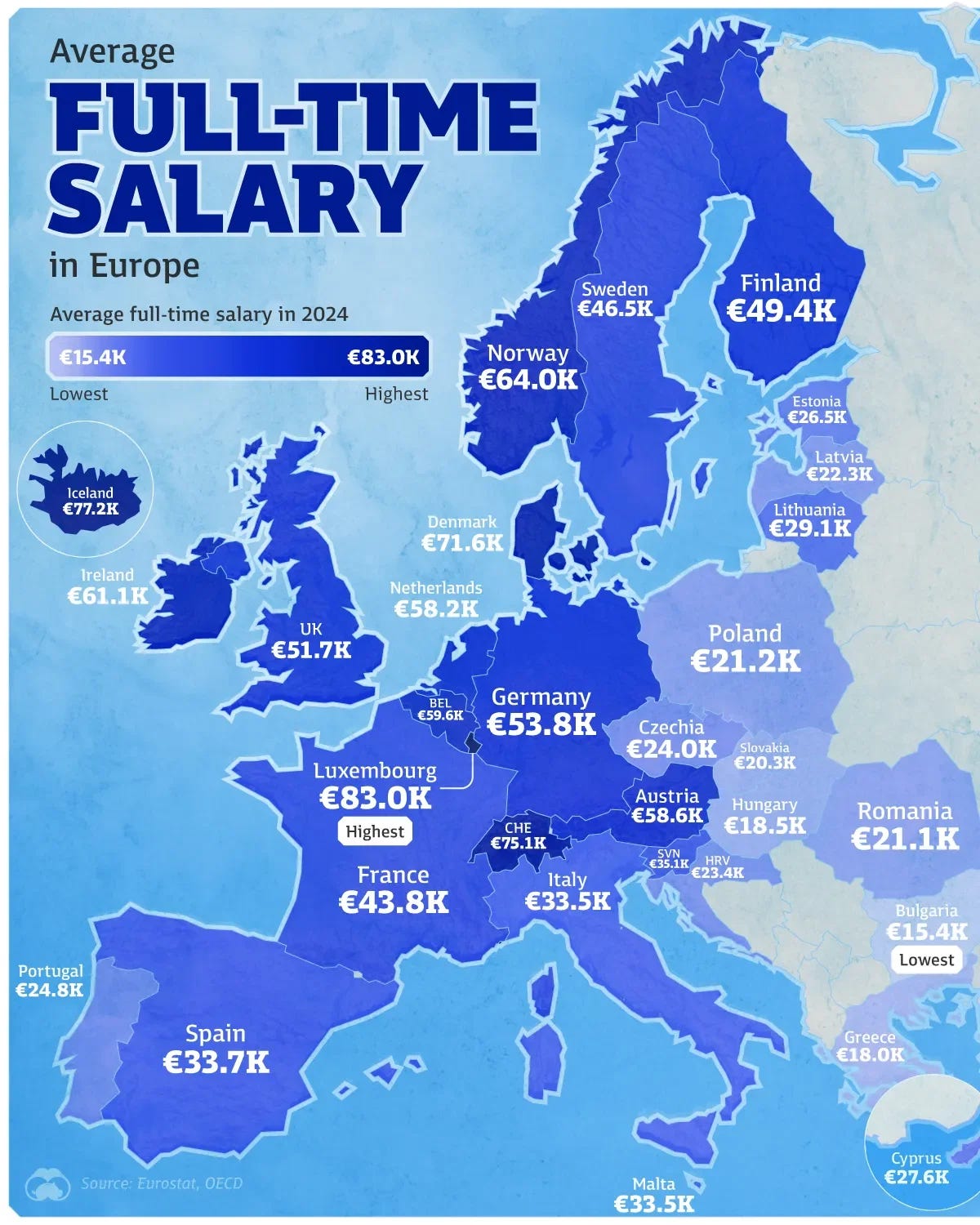
As a result of this heavy socialist presence in Nordic politics, Scandinavia is rife with some of the most effective socialist policies in the modern world. Ironically, Denmark has no minimum wage. They don’t need one. Minimum wages are set at the sector level through collective bargaining agreements between employers and trade unions. This social pact is called The Basic Agreement, and is the result of over 120 years of militant unionism. About 70% of the Danish workforce is covered by one of these agreements. As a result, the average Danish salary is 10% higher than in the United States, despite Denmark having higher unemployment rates and a lower GDP per capita. Simply put, Denmark’s multi-century tradition of unionism ensures Danish workers receive more of the value they create than American workers receive. So, when our libertarian oligarchs’ nepobaby says Nordic countries have higher labor force participation, that’s because workers get more for their labor. More reward, more participation. That’s just economics 101.
Mary Julia Koch also falls flat on her face when describing Norway’s oil sector, stating:
“By the way, Norway is Western Europe’s largest oil and natural gas producer. That’s the reason for their economic success, not the welfare state.”
Of all the things American socialists preach about the Nordics, nothing is cited more than the Norwegian energy sector. That’s because… it’s highly socialist!
In the late 1960s, Norway discovered massive oil reserves in its territorial waters. Thanks to socialist presence in the halls of power, the government moved to ensure the expendable resource worked for the benefit of the Norwegian people, not energy capitalists. In addition to taking a stake in private oil companies, the Norwegian government taxes oil drillers at a marginal rate of 78%. While there are still private aspects of the Norwegian drilling process, the Norwegian people democratically control the vast majority of oil profits. In the 1990s, parliament set up the Government Pension Global Fund to reinvest oil revenues, ensuring the expendable resource leads to sustained prominence for future generations. Today, the Global Fund is the world’s biggest single owner of listed stock shares and generates significantly more income from Norway than the oil revenue itself. The Global Fund is also limited by a tight ethics policy. In accordance with the socialist commitment to social justice, the Global Fund does not invest in tobacco companies, weapons manufacturers, companies deemed corrupt or emission-heavy, or any companies involved in the colonization of Palestine. In 2024, the Global Fund divested from Bezeq, a communications company that worked with Israeli settlements in the West Bank.
When it comes to judging Norway’s oil sector, Faildaughter Koch and I are in unanimous agreement. The socialist management of the energy sector is the reason for Norway’s financial success, and the United States would be wise to replicate it. We don’t even need to start from scratch. A similar system exists in Alaska, where the Alaska Permanent Fund Corporation collects oil revenue, invests it, and uses it to fund the state’s social programs. Declaring all oil under American soil the birthright of the American people would significantly decrease the value of Mary’s trust fund. So I doubt she truly wants us to replicate the model.

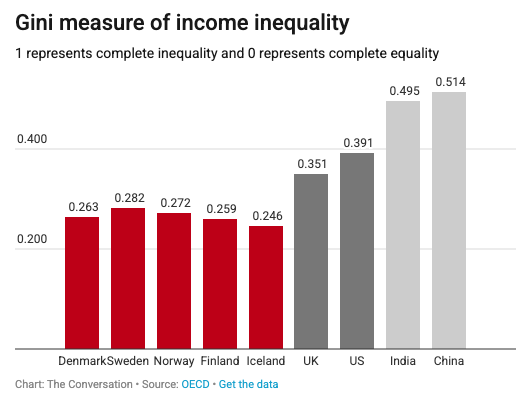
These are just two of the many ways Nordic socialism has delivered for their national working classes. With a pro-worker sentiment instilled in Nordic populations through long histories of Marxist and labor struggle, strong social programs have made the nations of Sweden, Finland, Denmark, Iceland, and Norway enviable in the eyes of all who seek to uplift the global working class. These countries have significantly lower levels of income inequality, a requirement for any healthy democracy. The populations are happier, suicide is lower, the press is freer, and they consistently rank highest among gender equality. Most importantly, all five of the Nordic countries lead the United States and the United Kingdom in the most crucial economic metric: life expectancy. In 2026, the lowest life expectancy throughout the Nordics was 82.4 years, a tie between Finland and Denmark. The U.K. and U.S. sit at 81.8 and 79.8, respectively.
Even worse than Mary Julia Koch’s analysis of Nordic social democracy is her explanation as to why these nations are able to institute these programs. To quote from Mary’s video:
“[The Nordic countries] are ethnically homogeneous and so much smaller than America. The entire metro population of New York City is four times the size of Norway. We’re comparing apples to oranges."
These are common arguments we hear from the right. For the question of size, they get it backward. If you want robust social programs such as Medicare For All and unemployment insurance, a bigger population is better. When more people pay into the pool, risk is spread out, and costs are mitigated. It’s actually better to have a bigger tax base for social programs than a small one. So by saying America is bigger than Norway, Mary is only giving us more ammunition to argue that these programs would be more efficient in the United States. This nonsensical argument about population size also ignores that the United States already has the foundation for many social programs. Infrastructure for Medicare for All, strong unemployment insurance, and universal child care has been built through Medicare, weak unemployment insurance, and the public school system. American socialists seek to broaden these programs’ mandates and fund them through higher taxation to serve our larger population. It’s really not that complicated.
As for the claim that Scandinavian nations have strong social welfare programs because they’re “socially homogenous,” this is thinly veiled racism that only exists in the reactionary mind. No, Norway does not socialize oil profits because there are no Black people in Oslo. And Denmark’s iconic sectoral bargaining doesn’t exist because the country is mostly Lutheran. This falsehood relies on the fantastical assumption that the Scandinavian social democracies became social democracies because a bunch of pasty-White people sat down at a table and agreed to turn the dial halfway between socialism and capitalism. These countries are only social democracies because labor fought capital and won a significant portion of the fruits of productive value. This is the battle between capital and labor that happens in every society, no matter what label you give it. And if these nations didn’t have strong socialist tendencies, then they would be just as deep in a capitalist hellscape as the United States.
I don’t know why everyone thinks Northern Europe is White Wakanda. They are not without class and violent conflict. In 2011, Neo-Nazi terrorist Anders Breivik killed seventy-seven people, mostly teenagers at the Norwegian Social Democrats’ summer camp. It was a political attack that was mostly covered as mindless violence by the American press. A leading financial sponsor of Ezra Klein’s Abundance movement granted $100,000 to the Swedish Neo-Nazi group Stiftelsen Nya Dagbladet in 2022. Reactionary rightism is alive and well in Scandinavia, thankfully suppressed by the socialist representatives of the working class.

Unlike in the United States, the Scandinavian nations generally adhere to the “democratic” part of liberal democracy. One reason Nordic socialists have had success is that these countries have a more level political playing field, enabling the working class to advocate for their interests. This is why American capitalists are so eager to suppress, diminish, and exclude DSA and other socialists from fair electoral participation. Until recently, there was little effective socialism in the United States thanks to decades of McCarthyism, COINTELPRO, blacklists, and assassinations. Members of the Democratic Socialists of America don’t highlight Norway, Sweden, and Finland because they are socialist utopias. We do because they show the first, welcomed step in what our project can achieve absent interference.
Not to brag, but this essay is 1000x more lucid and substantiated than anything Faildaughter Koch has put into the world. I’ve been told capitalism is a meritocracy, so I expect a job offer from The Wall Street Journal any minute.
If you appreciated this essay, please click the ❤️ to help it rise in Substack’s algorithm. Don’t forget to subscribe so future articles are delivered to your inbox. If you’re a returning JoeWrote reader, consider supporting my work with a premium subscription. For the cost of just one cup of coffee a month, you can help me keep creating content like this. Plus, you unlock everything JoeWrote has to offer.
Thanks in advance!
In Solidarity — Joe
Shoutout to Militant for getting such a special focus in that dogshit Atlantic article lmao. Socialist Alternative in the US was formed in the 80s by members of Militant. Proud to be part of the same political lineage as them.
Definitely well written and descriptive! Unfortunately many without knowledge will believe her as publication is widely read.