

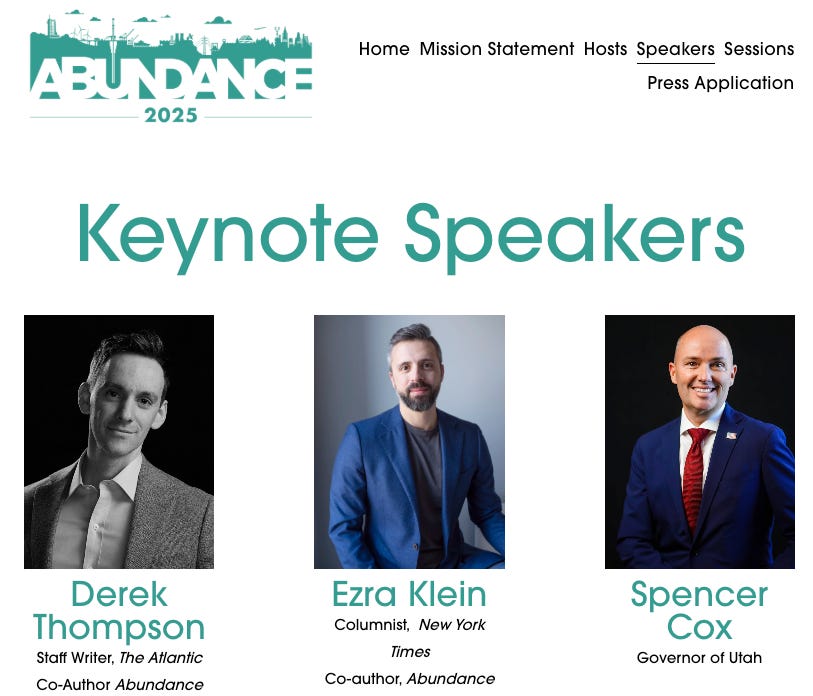
It’s been over a year since the launch of Abundance, the New York Times bestselling book by Derek Thompson and Ezra Klein. Before it even hit the shelves, Abundance had become a full-blown movement. Democratic politicians, operatives, and donors celebrated Klein and Thompson’s vision as the answer to Democrats’ electoral woes. Congressman Josh Harder founded the Abundance Caucus, and Ezra Klein was the honorary guest at the Senate Democrats’ 2025 issue retreat. Excited by a Democratic Party program that was sympathetic to corporate interests, Silicon Valley oligarchs backed Abundance projects with the GDP of a small country. Facebook co-founder Dustin Moskowitz invested $120 million into the Abundance & Growth Fund, one of many such donations. Last September, Klein and Thompson were keynote speakers at Abundance Fest 2025, which was funded by an assortment of billionaires, Trump-linked think tanks, and conservative interest groups. One financier, the Future of Life Institute, had granted a Swedish Neo-Nazi group $100,000 in 2022.
While the Abundance Movement predated the book, Klein and Thompson’s title helped transform the libertarian-esque project into a useful political weapon for powerful liberals. The book launched in March, 2024, right when the Democratic establishment was searching for its future. Having let Donald Trump stumble ass-first into the White House for the second time in a decade, the establishment old guard of the Democratic Party was embarrassed, defeated, and losing factional power to the party’s progressive wing. While minority leader Hakeem Jeffries was flying to Silicon Valley to apologize to donors, Bernie Sanders and Alexandria Ocasio-Cortez were energizing the Democratic base with their Stop Oligarchy tour. Having lost the American government to the right and at risk of losing the Democratic party to the left, the liberal establishment looked to Abundance as the excuse and answer it needed. The book blamed environmentalists and progressive interest groups for social delay, which fit nicely with the establishment’s claim that Trump won because progressives pushed the Harris-Walz ticket too far left. Ezra Klein aided this theory in more ways than one. Weeks after the election, he went on Pod Save America and scolded the ACLU for asking Kamala Harris about healthcare rights for trans prisoners in 2019 because the Trump campaign clipped her answer and used it in an attack ad.
At the same time, the ‘Abundance Agenda’ became the get-out-of-jail-free card for politicians looking to quiet the Democratic base’s demand for a bolder, progressive political program. The catch-all ‘Abundance mindset’ became the Democratic establishment’s political vision, urging the cutting of regulations so that private businesses could deliver goods and services that voters cared about. But there was only one problem. Abundance was never supposed to be a political program. And it certainly wasn’t a guide to mobilizing Americans against the violent state repression of Donald Trump’s second term. Derek Thompson admitted this during an interview with Nate Silver last year, in which he said he believed Kamal Harris would be in the White House when the book launched. Speaking candidly to Silver, Thompson explains that Abundance was one of the potential messages circulating in the Democratic Party. What he doesn’t say is that Abundance was the only one not critical of corporations and capitalism, making it appealing to Democrats with deep-pocketed donors.
Despite not providing political answers to the political questions of the second Trump era, Derek Thompson and Ezra Klein were happy to go along and pretend that Abundance was the solution to stopping fascism. During an interview with Lex Friedman, Thompson stated that their book was “trying to win a certain intra-left coalitional fight about defining the future of liberalism in the Democratic Party,” an explicit admission that he saw himself, Klein, and their Abundance ideology aligned with the corporate establishment.
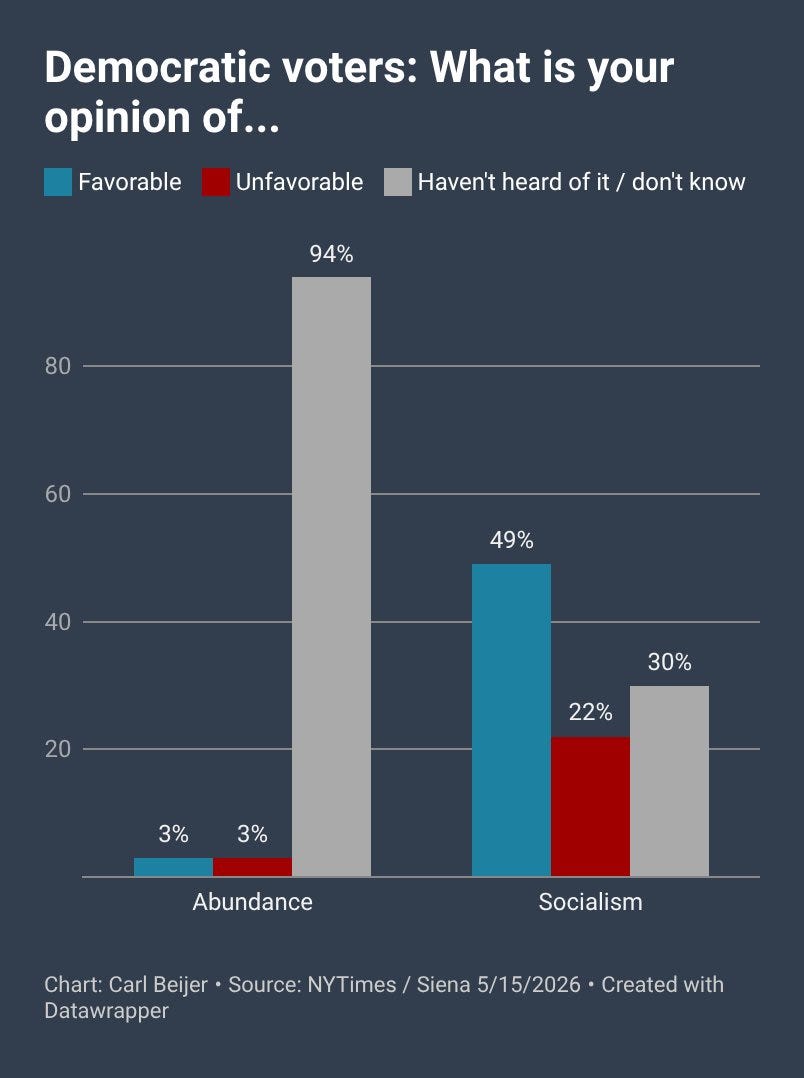
So, the authors wrote Abundance expecting it to be published under a milquetoast Democratic president. But when things didn’t go to plan, their book served a different purpose. Like shipwreck survivors grabbing any debris they can, the centrist establishment seized Abundance as a life-saving buoy and declared it as the Democratic Party’s path forward. And for the last year, that is what the establishment has been doing. There have been Abundance conferences, collegiate groups, think tanks, Substacks, policy papers, and anything else the political elite can slap “Abundance!” onto. But that’s all the Abundance craze has delivered. A year after the Abundance Movement was bolstered by a book written by household-name pop-politics bloggers, it has failed to gain traction outside the Democratic elite. According to a recent Times/Sienna poll, 94% of Democratic voters haven’t even heard of Abundance. Of those that have, it’s equally liked and disliked. By comparison, Democratic voters are keenly aware of socialism and very fond of it. [Chart courtesy of Carl Beijer]
This isn’t surprising, given how the Abundists presented their movement. In their closing chapter, Klein and Thompson detail a top-down strategy to bring the Abundance Movement to life:
“[The Abundance Agenda] requires deep-pocketed donors (and political action committees) to invest in promising candidates over the long term; the establishment of think tanks and policy networks to turn political ideas into actionable programs; a rising political party able to consistently win over multiple electoral constituencies; a capacity to shape political opinion both at the highest levels (the Supreme Court) and across popular print and broadcast media; and a moral perspective able to inspire voters with visions of the good life. Political orders, in other words, are complex projects that require advances across a broad front.”
This paragraph is a window into the worldview of the liberal elite. Klein and Thompson are focused on convincing the upper strata of political society: the Supreme Court, donors, think tanks, and political action committees. The only time they mention everyday people like you and me is to say that they must “inspire” us. Not listen to us, but to help us see what the elite Abundists have decided is in our best interests. Let me just say, I trust think tanks and “deep-pocketed donors” to do what’s best for the working class about as much as I trust the Israelis to honor a “ceasefire.”
But even if I did share Klein and Thompson’s trust in the elite institutions, the Abundance worldview would still fail to deliver the results it seeks for one simple reason. As liberals, Ezra Klein and Derek Thompson fail to account for the power of private capital. This oversight was obvious from the minute Abundance was launched. But as a recent one-year anniversary conversation between the authors shows, the liberal ideology behind the Abundance Movement still fails to address the most important component of American society. As a result, the authors seem out of touch, and even as they admit, their program is failing to deliver.
Abundance: Year One
To celebrate their book’s first anniversary, Ezra Klein invited Derek Thompson on his podcast for a conversation on the state of the Abundance Movement. They were joined by Marc Dunkelman, who published Why Nothing Works a month before Abundance was launched. The authors discuss how their books have held up in the year since publication, what they got correct, and where they went wrong.
While Klein and Thompson do admit their movement’s shortcomings, they fail to recognize that these shortcomings are not isolated mistakes but consequences of the liberal worldview behind Abundance. Specifically, Derek Thompson and Ezra Klein still don’t understand the unprecedented power of the American capitalist class. Sure, they say we must “get money out of politics” and “increase taxes on the ultra-wealthy.” That’s all well and good. But coming from a liberal perspective, in which private businesses are the owner’s property the same way the phone you’re reading this article on is your property, they view oligarchs as on equal footing to other sources of power, such as unions, community organizations, and interest groups. Abundance argues that because corruptive power can arise from anywhere, governments should eliminate opportunities for disruptive influence so that socially necessary housing, technology, and energy projects can uplift the American quality of life. This means eliminating. Sorry, “streamlining” projects by reducing the number of environmental reviews, building regulations, and community vetoes so Democrat-run governments can deliver the goods.
Here’s Ezra Klein describing his view in the anniversary conversation:
“I think that’s one other reason I’ve always said that the theory of power in ‘Abundance’ is liberal, in the sense that it believes power can concentrate poorly anywhere. It can concentrate poorly among corporations, in government, among unions, in neighborhoods. There is no safe concentration of power.”
To be fair, Klein isn’t wrong. Power can concentrate poorly anywhere. And sometimes it can concentrate in places where the interests of the few outweigh those of the many, causing problems for progressive projects. For example, during the 2020 Democratic Primary, Bernie Sanders’ Medicare for All plan was opposed by some labor unions who didn’t want to lose their union-negotiated health plans. This led to a brief row between organized labor and the most pro-labor candidate.
However, the potential for capital to misuse power is far greater than that of all other social groupings (especially progressive ones). There are two reasons for this. First, capital has considerable (if not all) social power. Because billionaires and oligarchs control society's productive forces, they have leverage over important decisions. Numerous studies have found America is an oligarchy, not a democracy. The small percentage of people who own damn near everything greatly overpower people like you and me, who don’t own very much. The working class (i.e., people who don’t own businesses) can increase their power by uniting in unions and other groups to advocate as a single voice. But, as evidenced by the fact that wealthy corporations still control America, the working class's unified power still doesn’t match that of the oligarchs. (Which is why we must organize!)
Second, capital has no interest in using its power for the public good. Private businesses exist to create profit. When capitalists use their power, it is 100% for their own benefit. Sometimes what benefits the private company can benefit society. As I’ll explain below, directing capital’s profit motive can advance the public good. But the Abundance view that the God-like power of the capitalist class and the much weaker power of the working class deserve equal weight and condemnation is a departure from reality.
Are there occasions where a local community group stops a necessary power line from being installed because they don’t want the eyesore? I’m sure it’s happened. But are unions, environmentalists, and every other pesky obstructionist conclave the Abundance authors point to equally as powerful and at fault as the unbridled corporate power dominating the United States? Of course not. The Abundance authors should have learned this during their book launch, when they incorrectly blamed excessive environmental reviews for sinking President Biden’s public broadband program. Ezra Klein went viral for triggering Jon Stewart with a story of how unnecessary environmental reviews and equity initiatives prevented low-income Americans from receiving free public broadband. In reality, the program never got off the ground because internet providers used their lobbying connections to destroy the bill from the start. All of the potential “misuses of power” from well-intentioned activists that Klein warned about didn’t matter. Because the power of private internet companies to protect their future profits was greater than all others combined. Klein later admitted he got the “facts wrong” about the 14-stage process he explained to Stewart, as shown below. But he didn’t retract his claim.
Believing that private capital, the most powerful force in human history, has equal power to the local school board or transportation workers’ union is wilfully naive. And if your understanding of the political situation is wrong, then your suggested political solutions will be the same.
Housing Collapse
Though they don’t reach the conclusion in their conversation, Ezra Klein, Derek Thompson, and Marc Dunkelman come so close (yet so far) to recognizing that their misanalysis of capital’s power and purpose is why their Abundance Movement has yet to deliver the results the book promised. While discussing the shortcomings of housing, arguably Abundance’s most central policy, the authors admit that their program has lagged in outcomes. But because they don’t course-correct by questioning Abundance’s core assumption that private business interests are the best way to reduce housing costs, the authors fall short of offering a helpful solution to the housing crisis.
Here’s Klein:
“I think a good critique of the book that I’ve heard is that we don’t talk very much about financing. One thing that has been hard is that even as a lot of yes-in-my-backyard bills are passing, as you mentioned quickly, the financing environment has gotten much worse, because interest rates went way up after the inflationary period.
And the second is that the cost of construction in a place like California is a very fraught topic because nobody wants to see wages go down. There’s a big deportation agenda happening under Donald Trump, which, as you mentioned, is making labor more expensive.
But even as there have been a lot of victories on zoning and exempting things from environmental reviews, the financing side has gotten harder.
I’ve definitely talked to mayors and others who say: Look, I’ve got all these projects I want to see go forward, and we’ve made it possible for them to go forward. But the financing of the projects is not penciling out, and we don’t have an answer to it.”
Klein is admitting what many critics of Abundance said a year ago. And though he’s saying it now, he aggressively disputed claims that non-regulatory issues were slowing housing construction during the 2025 Abundance launch tour. Just because you eliminate regulation does not mean for-profit developers will build. It might be a bad time to invest, or investors may see higher rates of return elsewhere. So though the Abundance Movement has succeeded in eliminating building regulations, apartments still aren’t being built. This is because private for-profit developers are interested in making a profit, not helping Democrats reduce rent rates. To put it in Klein’s words, “the financing isn’t penciling out.” Independent congressional candidate Austin Ahlman said something similar during our recent interview: It’s not profitable for developers to build new housing in certain parts of Nebraska, so many evicted Nebraskans end up in trailer parks.
Derek Thompson picks up where Ezra Klein left off and agrees with his co-author:
“I’m picking up the criticisms that I heard about financing, about the fact that if you want to build this level of housing, you need to be obsessed with the question of: How do we actually finance that construction? How especially do we make loans to developers, at a time of high interest rates, possible for them to keep up with the level of housing construction that you want?
Those are really, really strong critiques. I think they click into the story that we were telling, the 50-year story. But I do think that it is fair to argue that our book missed that very important ingredient.”
Even though the Abundance authors acknowledge the limitations of their housing program, they still fail to address them. They leave the question of housing financing open, something they’ll have to “circle back on.” But it’s not an open question. We already know how to ensure there’s funding for new housing projects: public funding. New York City Mayor Zohran Mamdani recently announced plans to address the housing crisis by building 200,000 new apartments funded by municipal bonds and City capital investments. Mamdani’s plan was announced after this conversation was recorded. And the Abundance authors have positive things to say about the New York City mayor. However, they have failed to address how the many real estate developers backing the Abundance Movement, who are hostile to publicly funded housing because it reduces their profit potential, can be integrated into a political program aimed at reducing rents. As Klein and Thompson admit, the for-profit interests of building developers and society’s need for more low-rent housing are often opposed. The Abundance authors argue that these interests can unite in a Democratic political program. But neither they nor the Abundance Movement can answer how this contradiction will be resolved.
Artificial Misintelligence
The other policy area where the Abundists greatly misunderstand the power of capital is artificial intelligence. Derek Thompson takes the lead here, given that he has made AI a core topic on his Substack. To be honest, I was surprised at how little substance Thompson has added to his thoughts on this emerging technology. Here’s Thompson:
“[In Abundance] We first imagine that the profits of artificial intelligence — because it is a technology that is built on human achievement and human intelligence — are taxed and redistributed to the public. Second, we envision that the workweek has shrunk, and implicit in the idea that artificial intelligence allows the workweek to shrink is the idea that to the extent that it reduces labor, that reduction of labor is not borne on the backs of a dramatic increase in unemployment but is rather distributed among a stable set of fully employed labor force that is working a bit less and earning more because of higher productivity.
If I were crafting an abundance A.I. message, I would say that it is rapidly looking like it’s going to become a multi-trillion-dollar industry. We have to restore the ability to tax corporations that could be among the most profitable in the history of capitalism. That’s part one: We want to tax these companies and redistribute their income to the people.
But we also need to think about what kind of labor market policies we can begin to build to ensure that there isn’t a displacement of workers, and so that if this technology makes people more productive, it results in something that looks much more like a four-day workweek than the equivalent 20% of the economy just being shunted onto unemployment.”
There are two parts to Thompson’s suggestions about AI. First, he suggests that AI companies be taxed at higher rates so their profits can be "redistributed to the public.” Second, he calls for “labor market policies” to ensure that advancements in AI technology translate into gains for the working class (“a four-day workweek”) rather than the capitalist class (“20% of the economy just being shunted onto unemployment”). This is where Derek Thompson’s liberal worldview fails to meet reality. If we take the classical view of economics — that artificial intelligence is simply any other industry — and a liberal view of American politics — that problems can be best solved through civic participation in the existing political systems — then Thompson’s idea would work. Congress could impose higher taxes on OpenAI, Anthropic, and other tech companies to fund schools, hospitals, and other public goods. Or, Congress could shorten the workweek to four days, spreading the gains of AI productivity throughout the economy. And that would all be well and good. But this is not how the world works. And it’s certainly not how the United States of America works.
Take the suggestion for a shortened workweek, for example. The current five-day workweek didn’t come about because capitalists and congresspeople read books that convinced them workers deserved Saturdays off. No, the five-day workweek came to be because militant labor unions fought and died for it. The campaign for a five-day workweek was a brutal and bloody struggle that spanned the 19th and 20th centuries. Socialists recently celebrated May Day, the international commemoration of the Haymarket Affair. During a 1886 rally for an eight-hour workday and five-day workweek in Chicago’s Haymarket Square, a bomb went off, and the police fired into the crowd. Authorities used the bombing to indict eight labor leaders on murder charges, despite only two of them actually being present in the Square. Such violent episodes were common in the multi-century fight for better working conditions. It wasn’t until the eve of World War II, when their labor was especially crucial to the war effort, that the struggle was peacefully resolved and a five-day work week was established.

Though modernity is less violent than the 1800s, capitalists are just as protective of their profits. Tech companies aren’t going to allow their wealth to be redistributed. If we want the benefits of artificial intelligence to go to the common good, we’ll need to fight capital. A recent landmark labor deal between Samsung and worker unions shows what this takes. After months of struggle and threats to strike, Samsung workers ratified a contract with the electronics giant, granting them a share of the profits generated by the AI boom. Semiconductor workers will now receive about 10.5% of the company’s operating profit, equivalent to a bonus of $400,000 per worker. If Derek Thompson truly believes the profits of artificial intelligence should be socialized, then he should be steering the Abundance Movement towards full-throated support for American labor. Because that is the only way we’ll get the social-democratic redistributionism he’s advocating for. Without a militant labor movement, tech companies and politicians will say they’re addressing the AI crisis, but won’t actually lift a finger to help American workers. How do we know this? Because they are profit-seeking companies, not the benevolent actors Abundance misunderstands them as.
Jasmine Sun has an excellent story in The New York Times about how tech oligarchs are fighting back against negative public perceptions of AI with fig leaves and PR statements. The mass displacement of workers is far from an inevitability, but Sun’s reporting shows that AI oligarchs are preparing for it. Keenly aware of the public’s distrust of them and their product, AI companies are publishing “radically progressive” white papers to give the appearance of social progress, but are stopping short of making these pledges a reality.
From Sun’s report:
This spring, as fears of A.I.-induced job losses were becoming impossible to ignore, OpenAI started to share solutions. In April, the company released a white paper outlining an “Industrial Policy for the Intelligence Age” that declares the necessity of ambitious New Deal-style policies to combat the concentration of wealth and power in firms like OpenAI. In Mr. Lehane’s telling, industrialization “really threw off that relationship between capital and labor” and facilitated the rise of “fascism and communism.”
Many of the ideas listed in OpenAI’s white paper are radically progressive: a 32-hour workweek, higher taxes on corporations and capital gains and a “public wealth fund” that provides all citizens an equity stake in A.I. companies. Others more clearly cohere with company interests, such as accelerating energy grid expansion and establishing a national “right to A.I.” that would give foundation models to schools and libraries.
Still, the document is vague on implementation mechanics and whether OpenAI will advocate the policies listed. In an emailed statement, an OpenAI spokesperson declined to provide examples of specific legislation the company supports, but said that it has talked to members of Congress and the Trump administration about their intent to contribute to a public wealth fund, among other ideas. — Silicon Valley is Preparing for a Permenant Underclass
(Here’s a gift link to Sun’s essay.)
OpenAI’s whitepaper is the corporate equivalent of Derek Thompson’s politics. Unless there is an actual movement forcing companies such as OpenAI to deliver on these promises, then the statements and whitepapers aren’t worth the gallons of water ChatGPT used to write them. Much like on the housing question, the Abundance Movement won’t be a helpful vehicle for delivering these gains because it is openly antagonistic to the labor movement required to force tech companies to share profits. As Abundance-pilled writer Josh Barro has stated, “Abundance will require fighting labor unions,” a sentiment shared by the many libertarian, conservative, and business interests who fund the Abundance Fest that Klein and Thompson were paid to speak at.

While the liberal Abundance authors are hesitant to admit Republican-aligned interests back their project, Barro has further expanded on this point, saying Abundance is a joint liberal-conservative project that goes beyond Klein and Thompson’s book. As expected, suppressing the labor movement necessary to make Derek Thompson’s proposed shortened workweek a reality will be an easily agreed-upon policy priority for the bipartisan neoliberal consensus that Barro celebrates.
“Yes, Abundance, the book, written by liberals Ezra Klein and Derek Thompson, espouses a vision of abundance that is premised on liberal values, and primarily aims to influence intra-coalitional policy arguments among liberals and Democrats. But abundance, the concept, does not belong to Klein and Thompson (or anyone else). And because abundance, the policy project, aims to alleviate scarcities that matter to conservatives and liberals — like our insufficient production of housing and energy — it presents a great opportunity for conservatives and liberals to work together.” — Abundance Is a Bipartisan Project
Thompson and Klein suggest roads to nowhere because their liberal worldview leads them to misunderstand capital as a thing—a collection of tools, software, and infrastructure owned by very rich people. This misunderstanding prevents their Abundance ideas from addressing reality and solving the problems they correctly identify. A more helpful understanding of capital is the Marxist view, which sees capital as a series of relationships that are ever-expanding in pursuit of higher profits. Capitalists and non-capitalists can’t be evaluated as equally powerful forces, with their wishes sometimes benefiting and sometimes harming the public. By nature of being a capitalist, one owns the productive elements of society, giving them considerably more power over non-capitalists. And that power will always be used to increase and protect profits, no matter the cost.
Shareholders and oligarchs don’t just sit back and let their dividends be turned into extra days off or redistributed to workers. They fight back. Politically, economically, and sometimes, violently. This is why neither Abundance, the book, nor Abundance, the movement, can serve as an effective anti-Republican political program. As Trump’s second term devolves into all-out domestic oppression and continuous foreign war, anti-Republican politics needs a program that can energize Americans and defeat Trumpism electorally, while also changing the disastrous over-empowerment of capital that caused Trump’s political rise. That program needs to be based on the on-the-ground American reality, in which capitalist exploitation and social power are growing out of control. In Delaware, a judge recently ruled corporations can vote in elections, the latest and most troubling sign of America’s descent into naked oligarchy. Meanwhile, energy shocks driven by the Iran War are decreasing real wages. In April, wages increased only 3.6%, while U.S. annual inflation increased to 3.8%. While consumers are struggling, American oil company stocks are raking in cash hand over fist. Some oil stocks are up almost 45%. This is because American oil capitalists are reaping higher profits due to reduced supply, at the expense of American consumers. If Abundists want energy costs to remain low, they’ll need to advocate for price controls, something the oil lobby has a history of aggressively lobbying against. In other words, the path to low electricity bills runs through disempowering Exxon and Shell.


Despite what the Abundance authors claim, there is no equivalent to this level of power misuse from local unions or environmental groups. The foremost driver of the desecration of America’s democracy and the cause of economic stress is private capital, with the unsavory political elements capitalism creates coming in a distant second. Just as Derek Thompson and Ezra Klein admit that their Abundance view, which sees private business as equal to any other social force, is a liberal view, I admit that my analysis of capital as the dominant force in modern America is a Marxist view.
I doubt Derek Thompson and Ezra Klein will adopt Marxism any time soon. But ideological labels shouldn’t stop them from recognizing the limitations of liberal analysis on a world that, whether you want to admit it or not, is determined by the clashing interests between those who own America’s productive forces and those who don’t. This conclusion isn’t buried in the second version of Das Kapital. It’s right in front of the Abundance authors, who come so close yet remain so far from recognizing it in their recent conversation.
Until the Abundance Movement addresses the undeniable power of capital, it will remain limited to the liberal elite. Perhaps they don’t mind that. But as for the future of anti-Republican politics, that would be a disaster. Much like the Biden Administration, historians will interpret any short-lived Abundance political project that seizes power as a slight deviation from the Trump political era. It will inevitably not curb capital’s unparalleled power, and as a result, will fail in its ultimate goal of creating a more hospitable, dare I say, abundant society.
If you appreciated this essay, please click the ❤️ to help it rise in Substack’s algorithm. Don’t forget to subscribe so future articles are delivered to your inbox.
If you’re a returning JoeWrote reader, consider supporting my work with a premium subscription. For the cost of just one cup of coffee a month, you can help me keep creating content like this. Plus, you unlock everything JoeWrote has to offer.
Thanks in advance!
In Solidarity — Joe
Proving yet again Democrats will grasp at any straw that allows them to continue delivering nothing or next to it to the people who elected them.
“But what if we tried the same exact thing we already have BUT we change the name?”