

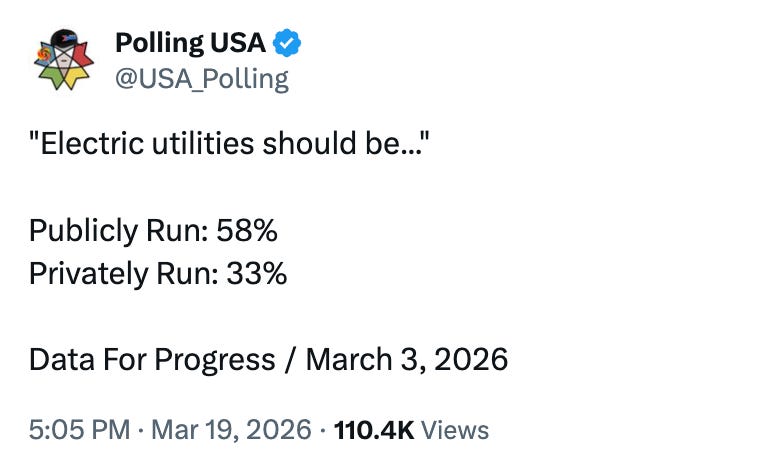
Recent polling from Groundwork and Data For Progress shows an overwhelming majority of Americans (+25) want electric utilities to be publicly owned and operated.1 It’s not hard to imagine why. Electricity rates have increased an average of 33% over the last five years, costing households approximately $420 per year. If you live near an AI data center, it gets even worse. Forced to compete with well-funded tech companies building these centers, some residents have seen their electricity bills increase by 267% once a data center comes to town. Then there’s the economic impact of Trump’s illegal war on Iran. With the Straight of Hormuz closed, American oil prices have increased more than 30%. A gallon now costs well north of $4. With over a quarter of all U.S. households and two-thirds of low-income households considered to have a “high energy burden” (spending over 6% of gross income on energy), electric costs are top-of-mind budget items for most American families. So, we don’t need to wonder why Americans would like to take electric utilities out of private hands and place them under public control. In other words, Americans want to socialize their electric grid.
Capitalism Is Not Markets
The most difficult challenge of advocating for socialism isn’t that people don’t know what socialism is — it’s that they don’t know what capitalism is.
Thanks to centuries of capitalist propaganda, most Americans believe capitalism is the “free market,” while socialism is when a government does something. This is incorrect. Capitalism is an economic and social system in which the means of production (businesses) are privately owned. They can be owned by one person, a small group, or many shareholders, as is the case with publicly-traded companies like Amazon and Google. Ownership determines whether an enterprise is capitalist or socialist. If workers own a business, either through a cooperative model or through nationalization by a democratically controlled government, then that enterprise would be socialist, not capitalist. This is because a business’s ownership structure determines the workers’ relationship to their workplace. Currently, Walmart is privately owned by stockholders, with the Walton family heirs controlling about 50%. So, when Walmart employees go to work, their relationship to their workplace is one of subservience — they have no control over working conditions, and most of the value their labor creates goes to the private owners. This is called profit. Comparatively, in a socialist model, workers control their workplaces. They’ll still have to follow the rules and can’t show up late or slack off, but they make company decisions democratically. More importantly, because there are no private owners taking profit, workers in a socialist model receive higher paychecks and better benefits.
It is the relationship between the worker and the workplace that determines whether an enterprise, and by extension our society, is capitalist or socialist. The biggest misunderstanding about capitalism is that it's defined by markets, which are a method of distribution.
Markets and central planning are two methods of distribution: how we allocate goods and services produced by enterprises. With over 70,000 worker-owners and businesses in most major industries, The Mondragon Corporation is the world’s largest worker cooperative. Because workers own and control their corporation, it is a socialist organization. Yet, many of these goods reach consumers through market interaction. With a strong retail presence, many consumers find Mondragon’s socialist-produced clothing in stores, hanging right next to clothes produced under the capitalist model. To the consumer, buying a Mondragon shirt is the exact same experience as buying an Abercrombie shirt. Though the former is produced by socialists and the latter by capitalists, because they are both distributed by a market, the consumer never notices a difference.
America Is Already Centrally Planned
While central planning is often used as a pejorative, an anti-socialist trigger word, many aspects of America’s capitalist economy are centrally planned by the state. The best example is the American energy grid. Outside of necessities needed to satisfy Maslow’s Hierarchy of Needs, electricity is arguably the most important commodity in the 21st century. If you don’t have electricity, you are deprived of modernity. Though electric companies are capitalist enterprises, with private stockholders making decisions and profiting from the company’s sales, the distribution of electricity is centrally planned. When you move into a new house or apartment, it’s likely you have only a single choice for which company to buy electricity from. This is because local, state, and federal governments work with private energy companies to plan which one is delivering electricity to your house. It’s always why private companies must deliver energy to rural areas under a duty-to-serve provision. Unless you have an exceptional circumstance, you didn’t choose your electric company through the market. There’s no Energy.gov to log onto and compare rates between EverSource and Xcel, then make the best choice. That decision has already been made for you by bureaucratic planners. You can either pay the company that has been centrally planned for you, or live in the dark.

Because of this dynamic, America’s energy grid is both capitalist and centrally planned. While capitalist production adds an unnecessary layer of fat and raises energy prices, centrally planning electric distribution is absolutely necessary. If every power company were free to install power lines wherever it wanted, neighborhoods would become perpetual construction zones. The street would have to be torn up and new lines buried every time someone signed up for a new provider. Dozens of wires would hang overhead, blotting out the sky. It would be a logistical nightmare, never mind the safety concerns. As the electrical grid is already centrally planned, it would benefit American society to streamline the operation and remove the middlemen from the equation. It’s not like these owners provide any integral service. The government tells them where they can and can’t put their lines and power stations. All they do is sit on their hands and collect checks from American families who are forced to cut back elsewhere to keep the lights on.
Of course, a majority of Americans don’t want to socialize the energy grid because they have strong beliefs in the supremacy of socialism over capitalism. It was their material conditions, the increasing cost of electricity shown in their budgeting apps, that led them to the obvious conclusion. As I wrote about recently, the stomach, not the brain, is the engine of social progress. Speaking to voters’ material needs, such as the potential to decrease their electricity bill by socializing the electricity grid, is the path to a better world.
Thanks for reading JoeWrote! If you enjoyed this article, please hit the ❤️ and subscribe to support my work. And if you’re enjoying JoeWrote (even sometimes), please consider upgrading to a paid subscription to support my work. Thanks in advance!
In Solidarity — Joe
Data For Progress is explicitly partisan, but I do find their polling question fair: Which of the following statements do you agree with more? Statement A: Electric utilities should be run by private companies, not state and local governments, because private companies deliver more reliable, cheaper services to customers. Statement B: Electric utilities should be run by the public sector, not private companies, because the public sector doesn't collect profits and can pass on savings to customers.
I work for an electric co-op, and live in another town where we have a different electric co-op for our utilities. I'm in TN, so we have TVA publicly providing our electricity, for the moment. (Unless Tangerine Jesus and the rest of the parasite class get their way and privatize it.) Both co-ops are member owned. Members vote for the board of directors and the goal of both companies is to provide the best service for the owners, who are the the customers themselves. There is no profit involved for anyone because that's just more that the members have to pay, and it would just go right back to them because they're the owners. It is an extremely effective model and the costs stay very low by comparison. It makes working here much better too because you're not constantly being trampled over or forced to work to make some random rich person even richer. And they take good care of the employees because of it. It should absolutely be made mandatory for all utilities to work this way, and all power production should be nationalized into organizations like the TVA. For Tennessee's many, many, MANY flaws, our electrical utilities aren't one of them. It's a model the rest of the country would benefit from. Well, the working class would benefit. Not the parasite Epstein class. So naturally they do not want it. It is deeply ironic that the area is very conservative, but we all benefit from socialist utility companies. The city owned utility in Chattanooga, TN built their own high speed fiber network and it turned the city into a major hub for tech companies. The for profit Internet gatekeepers, I mean "providers", absolutely lost their sh*t over it because it made them entirely obsolete
We have a pretty good sized credit union in the area that works the same way too, and is where I bank and will so long as I live here. Credit unions are member owned and thus the interests of the owners are the interests of the customers. All banks should be forced to follow the same model. The banking leeches would absolutely lose their gd minds if that happened. But I guess thinking like this is why I'm a dirty socialist. What with my extreme ideas, like affordable living and a thriving existence for everyone free from the tyranny of the rich. Insane... lol