

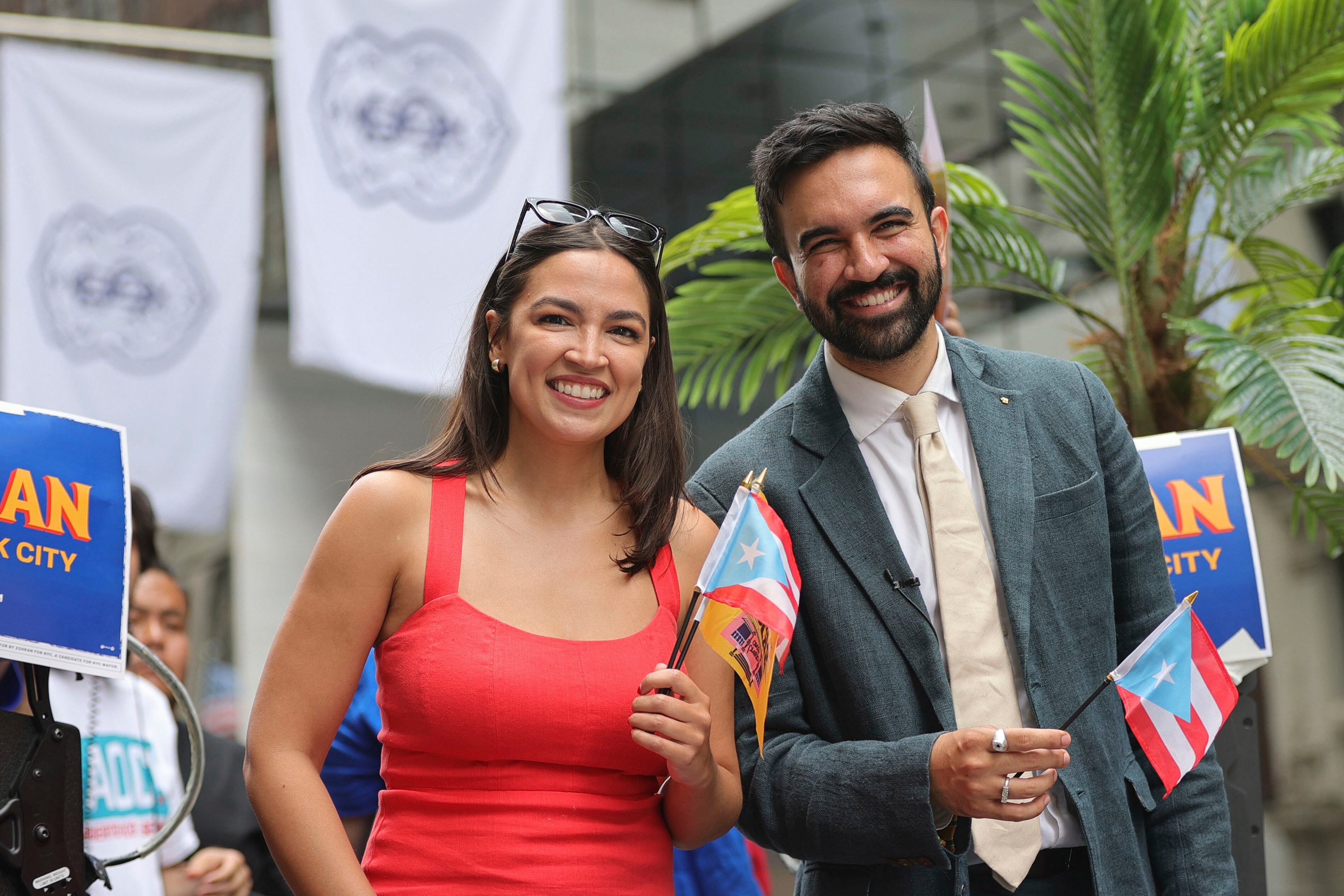
Caitlin Johnstone, a leading voice on the anti-imperialist left, recently published a critique of the political theory of Bernie Sanders and the Democratic Socialists of America. Entitled It’s Been Ten Years. It’s Time To Admit Bernie Sanders Was Wrong, Johnstone takes aim at the democratic socialist movement, particularly DSA’s strategy of running socialists on the Democratic Party ballot line. While Johnstone’s coverage of American imperialism is top-notch, she both misunderstands and misrepresents the strategy and objectives of the Democratic Socialists of America, the largest and most effective anti-imperialist political force in modern America. Here is Johnstone's description of the last decade of American left electoralism, as represented by Bernie Sanders:
“Some DSA guy told me the best way to make changes in US politics is to work within the Democratic Party to elect left-wing candidates and advance progressive agendas.
I said, ‘You guys have been trying that for ten years with nothing to show for it.’
I mean, how much longer is it going to take before people admit that the ‘change the party from within’ strategy isn’t working? Do you want another twenty years? Another fifty? Do you need to spend the next century watching a handful of vaguely progressive imperialists getting elected to Congress and then getting primaried out by opponents with mountains of special interest funding before you admit that you’re not making any meaningful gains? Our planet could be lifeless before then.
The Bernie Sanders ‘revolution’ was ten years ago. Large factions of the American left took up his call to take over the Democratic Party using primary elections throughout the nation, and ever since then it’s been a two-steps-forward, two-steps-back addition of zeros. The people never got President Bernie, and the few progressive gains made on Capitol Hill were either kicked out like Cori Bush and Jamaal Bowman or went full pro-establishment like John Fetterman. The few who stuck around have turned out to be perpetually disappointing empire managers like AOC, who know how to straddle the line between left-wing lip service and status quo swamp monster.”
There are many misconceptions here, but the biggest is that one decade is enough time to pass final judgment on Bernie Sanders’ efforts. There is no political project on earth that has achieved its end goals within ten years, especially one starting from the disadvantage of advocating for socialism in history’s most anti-socialist society. In addition to the straw man time limit, Johnstone’s description of DSA’s electoral success is categorically false.
She points to the 2024 defeats of Cori Bush and Jamaal Bowman as proof that the socialist left has only achieved an “addition of zeroes.” Johstone knows this is untrue. Her essay was published on July 9th. The week before, Denver DSA member Melat Kiros unseated a 30-year, AIPAC-backed Democratic incumbent in a blowout. The week before that, NYC DSA members Darializa Avila Chevalier and Claire Valdez defeated the Democratic establishment in their backyard. Avila Chevalier, a former organizer of the Columbia Palestine Solidarity Encampment, unseated the chair of the House Hispanic Caucus, while Valdez defeated the Brooklyn Borough President supported by dark Israel money. All three of these women are shoe-ins to win their general elections. So, while Johnstone points to two DSA losses, we had already recouped those seats and more in just the three weeks before she published. In all likelihood, more socialist victories are on the way.
DSA members are currently leading or in close races with their establishment opponents everywhere from Florida to Wisconsin to Michigan. DSA-backed Oliver Larkin’s is showing strong support in Southern Miami, forcing his hyper-Zionist opponent Jared Moskowitz to drop out of last night’s debate. After Bernie Sanders and DSA endorsed Donavan McKinney for Michigan’s 13th, Democratic leadership backed incumbent Shri Thanedar. Now, they’re leaking to Axios that they really don’t care about Thanedar, a sign that they’re pessimistic about the billionaire’s chances of maintaining his seat. Speaking of Cori Bush, she’s neck and neck with AIPAC-backed Wesley Bell to reclaim her old seat. And these are just the household names. According to DSA’s election tracker, our candidates have won 38 local, state, and federal races this year, with 87 more to go. Of course, the larger progressive movement led by Bernie Sanders is wider than DSA. Non-socialist progressives such as Analilia Mejia are flipping former Republican strongholds on strong anti-genocide, pro-worker platforms.
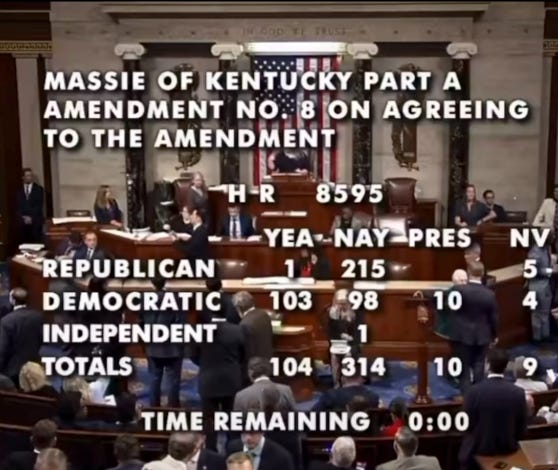
John Fetterman has never been associated with DSA, but he was considered part of the progressive wing while seeking election. Personally, I think people make way too much hay about Fetterman’s “political journey.” He was a vaguely progressive Democrat who had a stroke, gave himself multiple head injuries by repeatedly crashing his car at 80 mph, and is barely able to speak. Now, he has the cognitive function of a decaying grandfather, so I’m not surprised he became a far-rightist. As for Congresswoman Alexandria Ocasio-Cortez, she was the first congressperson to call for a ceasefire in Gaza after October 7th. Her recent amendment to the National Defense Authorization Act attempted to cut off all weapons sales and transfers to Israel by tightening the Foreign Service Act and its Leahy Amendments. As far as I can tell, it’s the most restrictive measure on Israel ever introduced to Congress.
The continued presence of DSA candidates and our progressive allies has shifted American politics in a way no one can deny. Two years ago, only thirty-seven House Democrats voted to stop sending weapons to Israel. But after the election of Zohran Mamdani, Darializa Avil Chevalier, Claire Valdez, Melat Kiros, and the grassroots energy nurtured and effectualized by DSA, things have changed. Two weeks ago, over one hundred House Democrats voted to cut off military aid to the genocidal state. Not because they had a change of heart. But because left-wing political pressure has them scared.
Johnstone’s article declaring this project a failure was published five days after the Democratic Socialists of America reached 120,000 members, making it the largest socialist party in American history. (We’ve added an additional 5,000 members since then.) To call this an “addition of zeros,” or say DSA has “nothing to show for” the past ten years of political organizing, is to greatly mislead readers about material facts.
Like many of DSA’s critics, on both the right and left, Johnstone misunderstands what DSA hopes to achieve by running candidates on the Democratic Party ballot line. This is born from a misunderstanding of both the Democratic Socialists of America and the Democratic Party, which is not really a party.
The best-kept secret of American politics is that neither the Democratic nor Republican parties are actual political parties. In other countries, political parties control their membership. Members must apply, pay dues, and submit to party-decided standards, giving the party extraordinary control over the individual. Comparatively, Americans don’t actually join the Democratic or Republican non-parties. They register as a “D” or “R” with their state government so they can vote in primaries, but that only matters if state law restricts voting by party affiliation, which most don’t. They also don’t pay dues or submit to party-determined guidelines.
This is why the British Labour Party was able to expel Jeremy Corbyn over his anti-Zionism, while the Democrats can’t expel Zohran Mamdani, Rashida Tlaib, Alexandria Ocasio-Cortez, or any other DSA member who advocates for workers and Palestine. In 2024, Labour’s National Executive Committee voted to prevent Corbyn from receiving the Labour endorsement in his election, then revoked his membership when he decided to run as an independent. Much to the Democratic establishment’s chagrin, they can’t do this to DSA candidates, which leaves an opening for the socialist movement.
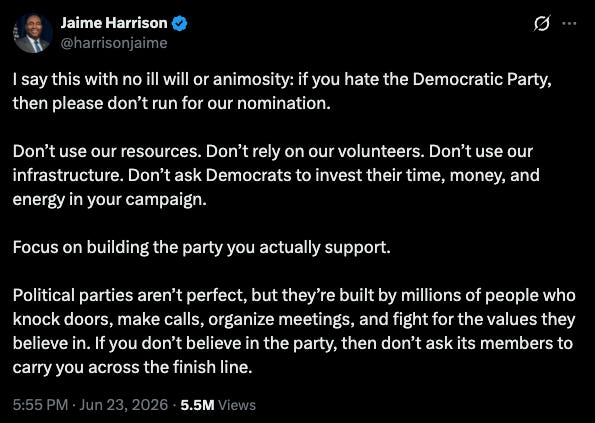
Unlike in Britain, to be listed as the Democratic nominee in a general election, all a candidate must do is win the Democratic primary. This open membership format is a major reason the GOP and Democrats control 99% of effective political activity in the United States. But the duopoly’s strength is also its Achilles Heel. By including every American, the Republican and Democratic non-parties forfeited the right to exclude any American. Unable to stop us from convincing Democratic voters, all the Democratic establishment can do is beg. The day after DSA candidates swept the New York City primaries, former Democratic National Committee Chair Jaime Harrison was reduced to pleading with democratic socialists to stop running on the Democratic ballot line.
Johnstone’s critique that DSA is trying to “change the Democratic Party from the inside” is common, but misinformed. We also receive this criticism from the right. A recent Atlantic essay warned Democrats that DSA was reusing the old Trotskyist tactic of entryism, joining the Democrats to cynically warp the party from within. But DSA does neither of those things. We are simply running socialists where they have the best chance of reaching the working class and winning power. In Democratic strongholds, DSA runs in primaries to conquer the Democratic ballot line. But not if we don’t need to. The night Zohran Mamdani won his iconic victory in New York City, DSA had endorsed twenty-three candidates across the country. Only five were Democrats, and one of those five was a member of the Communist Party U.S.A. (CPUSA). What puzzles me about Johnstone’s critique is that DSA is not the first socialist organization to seize the opportunity of the Democratic ballot. CPUSA has been doing it for decades. In 1973, Black Panther Party co-founder Bobby Seale ran for mayor of Oakland on the Democratic ballot line. In an election-time interview with The Iconoclast, the iconic revolutionary warned against the abstentionist thought embodied in Johnstone’s essay:
Iconoclast: “I guess the main questions have to be why are you running for mayor of Oakland? Can you win? And why have you decided to work within the system?”
Bobby Seale: “First thing is you can’t drop out of the system, because the system itself becomes interconnected with the very oppression. You cannot have exploitation without having somebody there being exploited. You cannot have racism without somebody having racism perpetrated upon them. So what we call the “power structure” is the system becomes interconnected with our total existence on the face of this earth. Agnew lives on this Earth. Nixon lives on this earth. Black people are oppressed on this earth, be they in Dallas, Oakland, California, or Africa. We all live on this earth. So our earth and our people and the system become interconnected with the universe, and the system is as broad as the universe. If you think you can drop out of the universe, try doing it.”
Though Seale lost his race, he forced the establishment Democrat into a runoff that gave both Seale and the Black Panthers much-needed national attention and legitimacy. Like Seale, DSA holds little regard for the status of the Democratic Party. It is simply a de facto part of the American electoral process. Engaging with it can unlock progress, while refusing it leaves socialism obscure and ineffective.
We also must examine what Johnstone provides as an alternative to the Bernie Sanders and DSA strategy. Here is what she writes:
“It’s time to admit the commies were right, kids. The factions on the so-called “far left” who’ve been rejecting electoral politics and calling for real revolution against a system designed to suppress leftward movement have been completely vindicated over the last decade.”
There are many words I would use to describe the DSA-critical leftists who reject electoral politics. “Vindicated” is not one of them.
Since Bernie Sanders announced his campaign in 2016, there has been a persistent chorus of voices from “far left” (to use Johnstone’s terminology) telling DSA and progressives that their efforts would be in vain. As Johnstone states, these leftists prefer “real revolution.” As we’ve seen, the Democratic Socialists of America and its progressive allies have achieved great success by running on the Democratic ballot. Meanwhile, those to our left have achieved, to be charitable, absolutely nothing.
The problem with critiquing the “far left” is it doesn’t really exist. What party should I be looking towards for non-electoral socialism? Is there a political leader whose work I am unfamiliar with? The closest thing this DSA-critical tendency has to a party is the Green Party, which has gone off the rails in the last few years. During the 2024 election, many on the “far left” insisted the Green Party ticket of Jill Stein and Butch Ware were our saviors, and if you didn’t support them it was because you loved capitalism and Israel. The Stein-Ware campaign aimed to receive 5% of the vote, which would unlock public funds for a 2028 rerun that (according to the Stein supporters) was guaranteed to win and magically topple the duopoly. But the online hype never translated to actual success. The 2024 Stein-Ware ticket failed to achieve its modest goal, only receiving .56% of the total vote share, 600,000 votes less than Jill Stein had received in 2016. What few leftists are willing to defend this record claim this was an “educational” campaign for future Green Party efforts. But Butch Ware couldn’t even get on the ballot for California’s gubernatorial race, something sixty other candidates were able to manage. So even the educational aspect failed. Outside the Green Party, there’s a scattering of socialist microparties that share Johnstone’s preference for “real revolution.” But they’re too busy fighting with themselves to build anything close to an effective national political platform, which is why you’ve probably never heard of them.
What little energy remains for this strain of purity leftism has been channeled into Kshama Sawant’s long-shot independent bid for Congress. An orthodox Trotskyist, Sawant sees enemies in everyone, everywhere, at all times. After months of running for Seattle’s 9th Congressional district by criticizing DSA, AOC, and Mamdani, Sawant is currently in a multi-month Twitter feud with her own SuperPAC. The Trotskist also rejects the Palestinian-led movement to Boycott, Divest, and Sanction Israel, putting her well to DSA’s right on the Palestine issue.
I’m not someone who will tell you that DSA’s approach to socialism is the way. This is why I’m baffled Johnstone uses the term “vindicated” to describe her political tendency. No socialist will be vindicated until their program creates a society in which each labors according to their ability and receives according to their means. And, most bafflingly about Johnstone’s claim of vindication is that there has not been a communist revolution in the United States, so it’s not like the “far left” has achieved its goals. I’m not even sure what their goals are.
There are many ways one could build socialism in the United States without engaging with the Democratic Party, or even independent electoral politics. The “far left” could have spent the last decade building militant rank-and-file trade unions to challenge capitalist power in the workplace, constructing an anti-war street protest network that frightened politicians away from belligerency, or organizing cross-city tenant unions to take the fight to landlords. But the far left didn’t do any of that. They mostly posted and podcasted, while DSA won massive gains on and off the Democratic ballot line while building the non-electoral infrastructure the far left claims to want. That’s the ironic thing about this conversation. If you Thanos-snapped every DSA Democrat out of existence, the Democratic Socialists of America would still be far ahead of our left-wing critics. We have a fully functioning labor organizing arm, unparalleled cultural power, and connections with international socialist and communist parties. The relationship between DSA and our left-wing critics isn’t one of competing parties driven by ideological agreements. Rather, it’s more akin to the relationship between an NFL team and Monday morning armchair quarterbacks. After all, “far left” isn’t really a political movement. It’s mostly the small but vocal audience of bloggers and podcasters who are focused on monetizing their niche, not driving change, revolutionary or otherwise.
I don’t believe DSA’s theory of socialist change is The Proven Way to do socialist organizing. We won’t have the right to claim vindication until socialism has been achieved. But, thanks to our Marxist analysis of contemporary America and our realistic theory of change, we are light-years ahead of every other sect, tendency, and party on the American left — especially Caitlin Johnstone’s “far left,” which doesn’t even exist.
If you appreciated this essay, please click the ❤️ to help it rise in Substack’s algorithm. Don’t forget to subscribe so future articles are delivered to your inbox. If you’re a returning JoeWrote reader, consider supporting my work with a premium subscription. For the cost of just one cup of coffee a month, you can help me keep creating content like this. Plus, you unlock everything JoeWrote has to offer.
Thanks in advance!
In Solidarity — Joe
I was in a Leninist style vanguard party many years ago. For many decades there were always 5-10 little parties like this in the US, all variously Maoist, Trotskyist, Leninist, etc. selling newspapers and constantly imploding or splitting.
Those groups had literally zero to show for all their work, at best they were keeping the candle lit for a political tradition, but they weren't meaningfully growing in size, they weren't generating news, they sure as hell weren't capturing any political power, and they weren't taken seriously by anyone as a genuine alternative. Most no longer exist at all.
As bad as things are now in the American political system overall, 10 years ago the environment was much much more static for any socialist politics. Not long before that the great hope of progressive politics was Dennis Kucinich. Things were fucking grim.
Socialism entering the discourse, becoming the boogeyman of the right, and growing in popularity among younger demographics, exactly tracks the rise of the DSA.
There's a long long way to go, and there's no guarantee that this approach will work, but I can sure fucking tell you that the kind of politics Caitlin Johnstone would sign off on was going absolutely god damn nowhere. We have some traction now, we did not before.
The online discourse gets caught up in labels (and tedious purity tests), but I think a huge part of DSAs recent successes is simple; they’re meeting people where they’re at instead of the other way around.