

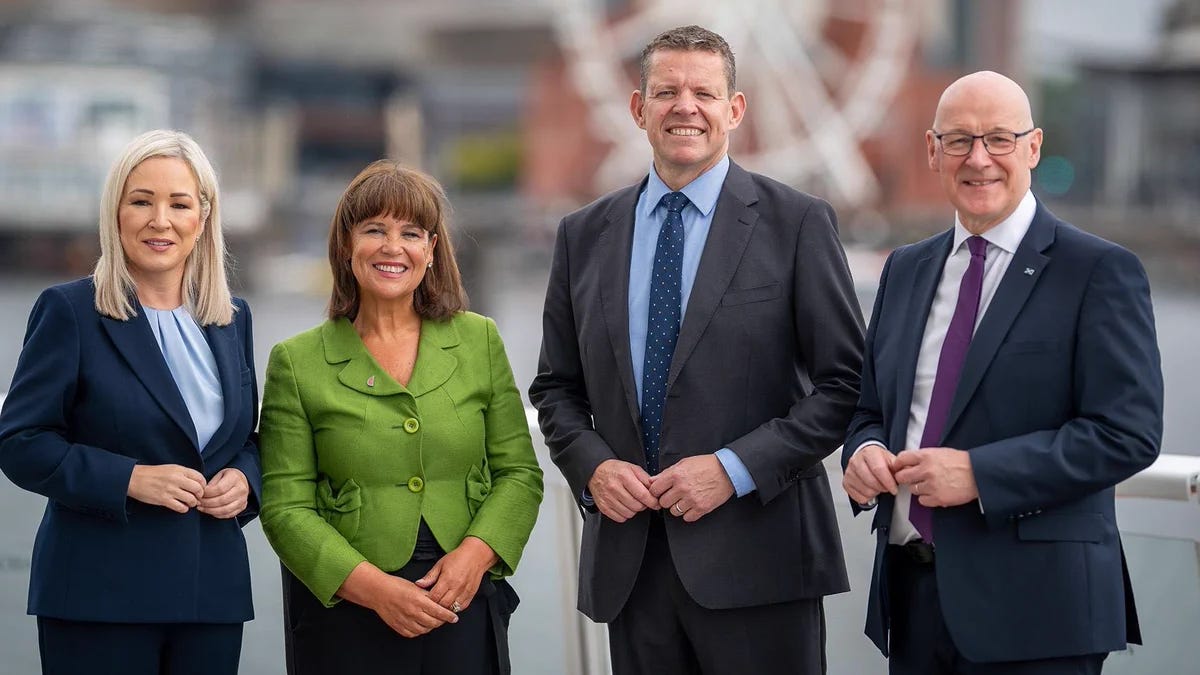
Yesterday, the leaders of Scotland, Wales, and the North of Ireland signed a joint statement announcing intent to dissolve the United Kingdom. Independence movements are hardly new in the British Isles. Its history is filled with rebellion and strife. But this is different. For the first time, independence parties hold first minister positions in all three Celtic nations. The statement was signed by Plaid Cymru leader and first minister of Wales Rhun ap Iorwerth; Scottish National Party (SNP) leader and Scottish first minister John Swinney; Vice President of Sinn Féin Michelle O’Neill, who leads the government in British-controlled Ulster; and Sinn Féin President Mary Lou McDonald, who leads the opposition in the Republic of Ireland. Clearly, the Celtic nations want out — call it a Cexit.
Though these pro-independence parties have existed for centuries, the post-Brexit British turmoil has birthed the conditions for their ascent to power. In May, Plaid Cymru ended a century of Labour rule in Wales, while Swinny and the SNP reestablished itself as the largest party in Scotland. Sinn Féin has led the mandated power-sharing government in the North of Ireland since 2024. Combined with its Southern block, what was once the political wing of the Irish Republican Army is now the largest party in the Irish nation.
Neither this statement nor increased calls for separation should surprise Westminster. Britain has been rudderless since it elected to leave the European Union in 2016. Seven prime ministers have come and gone since the June 2016 election, each failing to improve the quality of life of everyday Britons. Like the United States, the United Kingdom faces an ongoing cost-of-living crisis that defines its domestic politics. The short-term cause can be traced to the 2008 financial crisis and COVID-era inflation, but its real roots lie in decades of austerity pushed by the Conservative and Labour governments alike. Britain’s insufficient welfare programs have covered the average cost of essential goods in only two of the last fourteen years. And those two were only due to the temporary benefit increase during COVID. Real average weekly wages have fallen in Britain since 2008, and remain significantly lower than in continental Europe. The U.K.’s formal exit from the European Union in 2021 has only worsened the problem. According to the Office for Budget Responsibility, Brexit cost Britain 4% in productivity and a 15% decrease in both imports and exports, among other unnecessary economic pains. Independent studies have confirmed these findings:
“By the end of 2025 Brexit had reduced UK GDP by 6% to 8%, with the impact accumulating steadily over time. We estimate that investment was reduced by 12% to 13%, employment by 3% to 4% and productivity by 3% to 4%. These negative impacts reflect a combination of elevated uncertainty, reduced demand, diverted management time, and increased misallocation of resources from a protracted Brexit process.” — The Economic Impact of Brexit
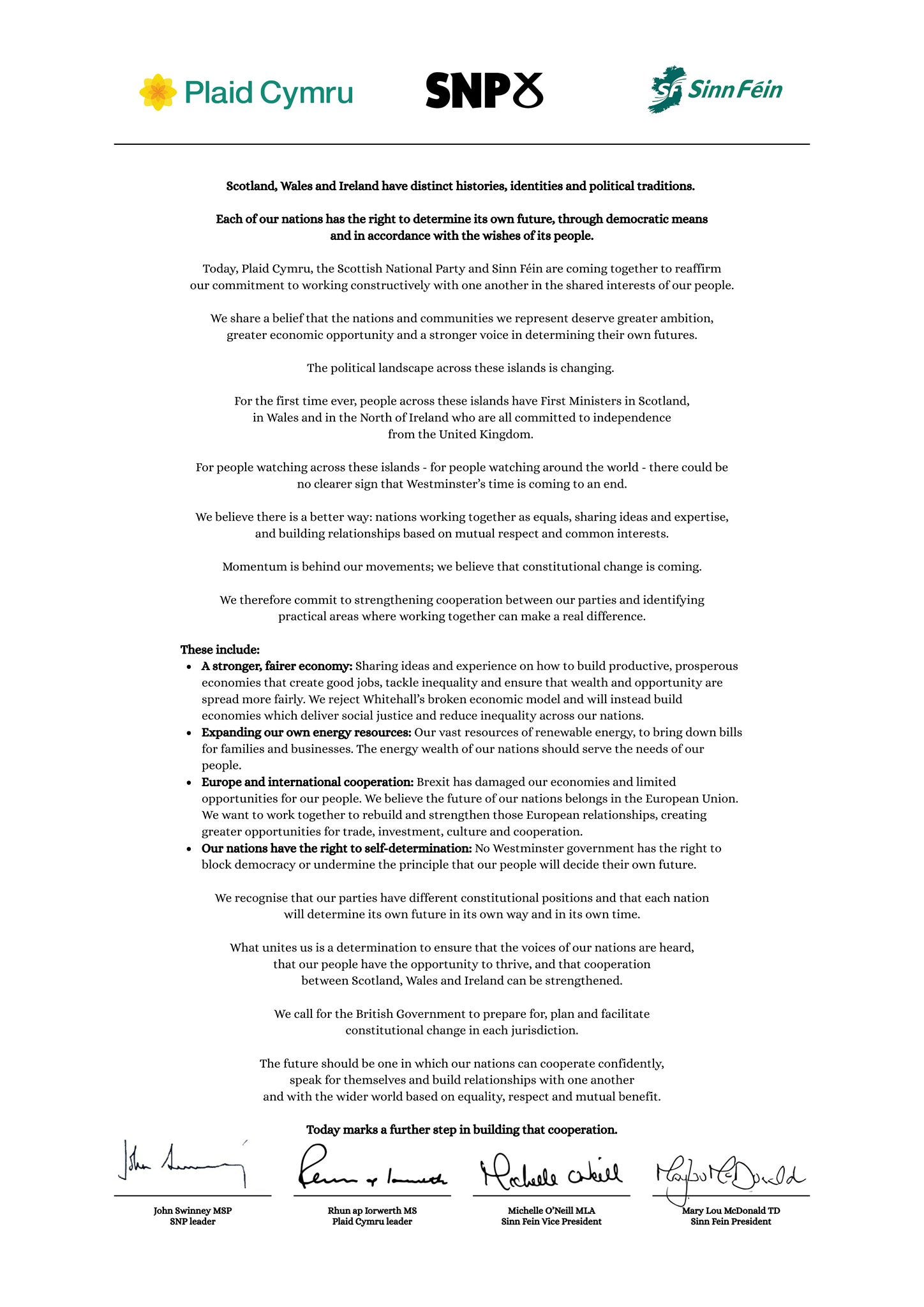
After Keir Starmer’s government collapsed earlier this summer, Andy Burnham became the new Labour Prime Minister with a promise to address the crisis. Burnham has pledged a 10-year plan to lower living costs through public housing investments and welfare improvements, along with Mamdani-esque policies to cap bus fares and crack down on predatory subscription pricing. It’s a welcome start, but many doubt the post-Corbyn Labour Party has the skill, knowledge, or spirit to deliver the change Britons want. Once a strong workers’ party, Labour neoliberalized throughout the 20th century. The death knell for working-class politics rang when Tony Blair stripped the socialist pledge to “secure for the workers by hand or by brain the full fruits of their industry” from the Party platform in 1995 and replaced it with some gobbledegook about Britain chasing its dreams or whatever. With an unapologetic excision of the British Left under Keir Starmer, the modern Labour Party’s foundation is that a capitalist economy and a bellicose foreign policy are good for all. Now that Britons are asking for systemic change, I’m doubtful Labour will be able to deliver the very thing it has spent decades decrying.
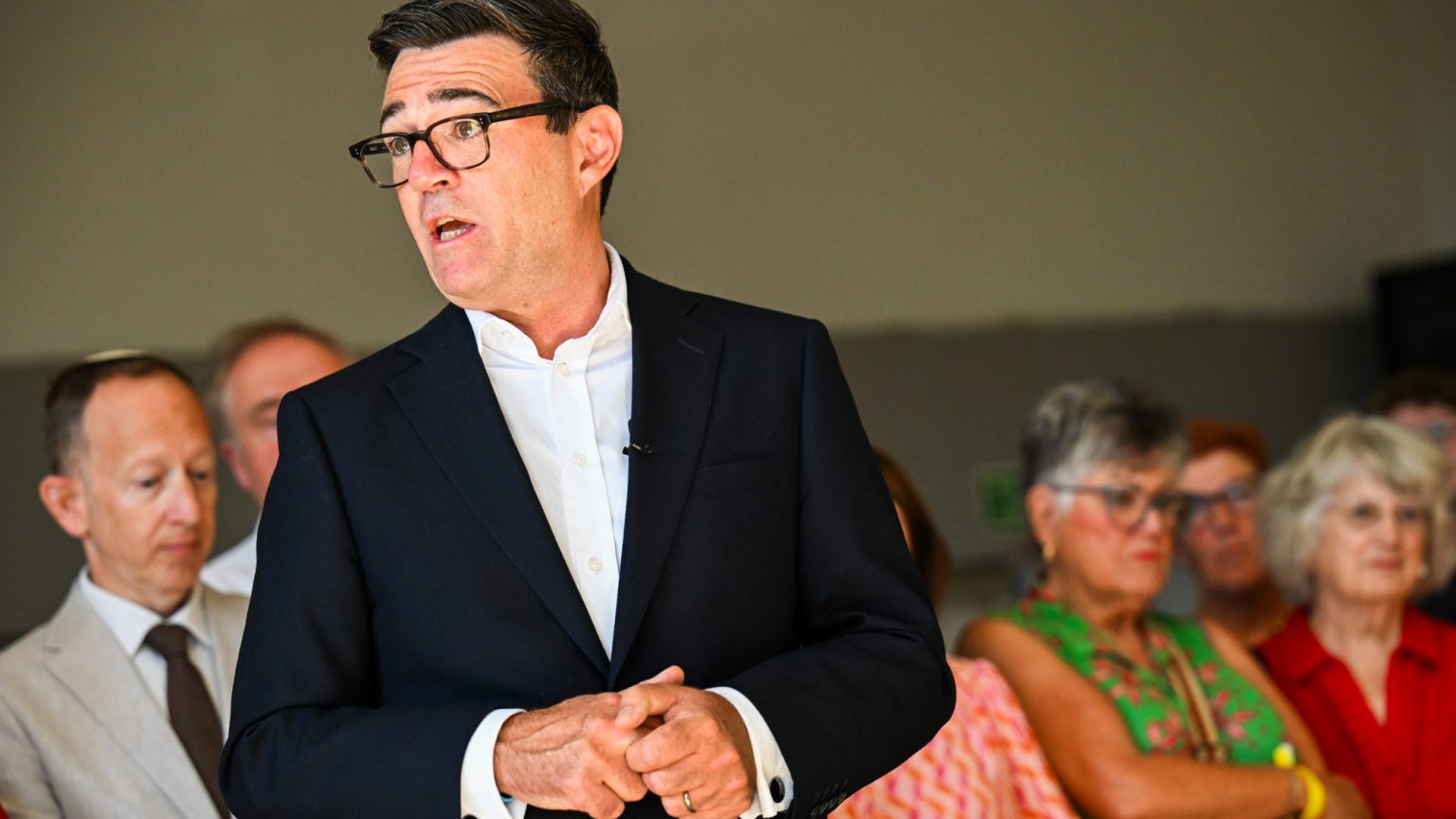
Deteriorating living conditions and a menu of dissatisfying political options have emboldened calls for Irish, Scottish, and Welsh self-governance. Of the four points of unity listed in the statement, three speak to the economic need to sever ties with London. The authors advocate for “a stronger, fairer economy,” using energy resources to “bring down bills for families and businesses,” and cite Brexit’s “damage to our economies” as a reason they want to join the European Union independently. The final point rounds out the economic concerns by framing them as one aspect of self-determination, declaring, “No Westminster government has the right to block democracy or undermine the principle that our people will decide their own future.”
While the economic grievances can be traced to near or distant history, the fourth point was intended to rebut Burnham’s recent declaration to Stormont that there would be no vote on Irish reunification during his tenure. This clearly violated the 1998 Good Friday Agreement, which Burnham excused by saying he sought to “bring people together.” Perhaps the British executive is unaware, but the people of Ireland (and, evidently, Scotland and Wales) very much do not want to be “together” with England. Quite the opposite, in fact.
With Britain in a tailspin, deteriorating economic conditions, and explicitly anti-democratic statements from a prime minister just weeks into his term, it's no surprise the Celtic nations chose this moment to make their move. But another catalyst is at play here, one not unique to England or its disgruntled neighbors.
For a long time, England could quell such calls for independence by arguing the benefits of remaining in the Empire outweighed the negatives. Veteran readers know I don’t shut up about Irish rebel leader James Connolly, who upset his Fenian comrades by loudly asserting independence movements would fail until rebels provided better living standards for the common folk than Britain did. Connolly was correct. Despite the horrors of colonization, fear of losing their economic sustenance was enough to deter most subjects from nationalist projects — and the British Army was dispatched to convince those needing more convincing. But fast forward to now, and the status quo isn’t working. Currently, the only thing the Celtic nations are getting from London is declining wage growth, lost economic gains of association with the European Union, a revolving door of prime ministers, and increasing right-wing British nationalism that frequently denigrates them. Plus, the British Government went against its subjects’ wishes and supported the colonial genocide of Palestine.
Across the world, the established order is failing, driving interest in political alternatives once deemed too radical for consideration. Neoliberalism has left workers on the cusp of poverty, imperialism is producing nothing but death and destruction, and conservative jingoism is fueling stupid political decisions, such as Brexit and absurd trade wars with Canada. While the Welsh, Scots, and Irish once asked what they had to gain from leaving the United Kingdom, now they wonder why they’re sticking around. More and more, the working class is asking simple questions about how their nations are structured, and if systemic change is necessary. As the call for Celtic independence shows, such questions are being answered with a resounding “Yes.”
If you appreciated this essay, please click the ❤️ to help it rise in Substack’s algorithm. Don’t forget to subscribe so future articles are delivered to your inbox. If you’re a returning JoeWrote reader, consider supporting my work with a premium subscription. For the cost of just one cup of coffee a month, you can help me keep creating content like this. Plus, you unlock everything JoeWrote has to offer.
Thanks in advance!
In Solidarity — Joe
Also the funniest thing is to have England just by themselves. Not even control over their island lmao
Finally a historical moment I’ve been wanting to see