

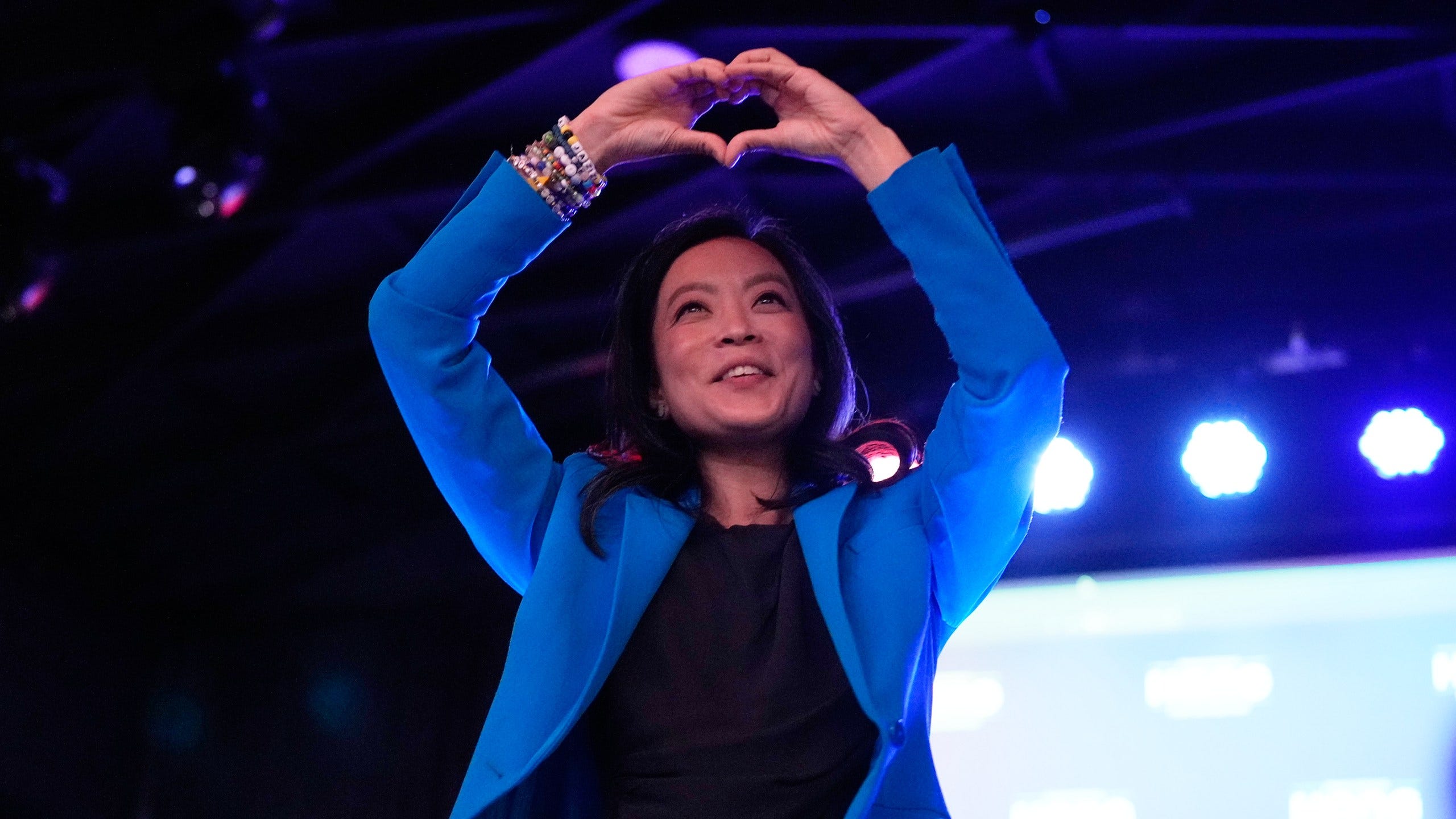
To the disappointment of the Democratic Socialists of America, Francesca Hong lost her race in the Wisconsin Democratic Primary. Much like Abdul El-Sayed, Hong was seen as a test of the progressive left’s capacity to win statewide elections in battleground states. Also like Abdul El-Sayed, the polls were way off. Pollsters accurately predicted Hong’s vote share at around 39%, and she received 40%. What was misjudged was support for David Crowley. The race began with a crowded centrist field vying for the right to challenge Hong, the unchallenged progressive torchbearer. Lackluster support and scandals forced many of the centrist candidates out, including Crowley. After Mandela Barnes, the leading establishment pick, dropped out after personal allegations, outgoing Wisconsin Governor Tony Evers resurrected Crowley and anointed him as his successor. The pair spent the last two weeks of the race joined at the hip. Beloved by Wisconsin Democrats (Evers’ favorability is a towering 85%), Evers hammered Hong on her perceived weakness in general-election electability. When asked if Francesca Hong could defeat Republican Tom Tiffany, Evers was blunt: “Probably not.” Electability is a top concern for Wisconsin Democrats. The state is still haunted by the disastrous austerity of Republican Governor Scott Walker, who used Wisconsin as a laboratory for the Heritage Foundation agenda. From 2011 to 2019, Walker cut education spending, stripped public-sector workers of bargaining rights, rejected Obamacare expansions, and gave large tax breaks to corporations that promised jobs that never came. Most disturbingly, Walker and the GOP legislature tried to disempower the incoming Democrat Tony Evers during the final weeks of his term. Much of the Trump Administration’s Project 2025 program was tested in Wisconsin. And Wisconsinites hated it. To Hong’s detriment, Evers and Crowley’s electability strategy worked. Over one third of Democratic primary voters said Evers’ endorsement drove them to support Crowley, giving him just enough to eke out a half-point victory.
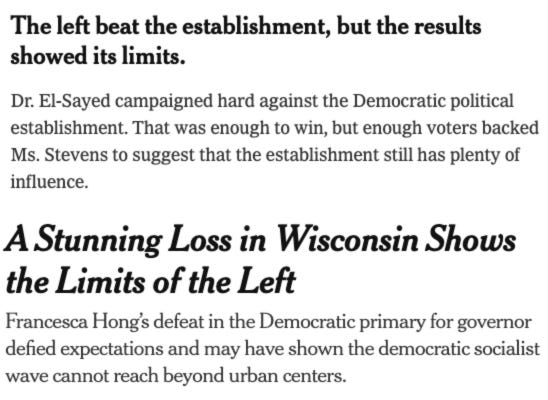
As expected, the media and conservative Democrats seized on Hong’s defeat to announce victory on par with the dissolution of the Soviet Union. The New York Times declared the loss “stunning” and said it “shows the left’s limits.” But they said the exact same thing about Abdul El Sayed’s victory, so we all see what’s happening here. Politico, ever eager to defend the entrenched powers of the status quo, declared, "The Socialist Fever Breaks.”
The naysayers are overplaying their hand. Four years ago, there was no socialist caucus in the Wisconsin legislature. In less than one presidential term, Wisconsin socialists went from nothing to coming within .5% of winning the governor’s office. Stepping back from the national focus, DSA endorsed twenty candidates who stood for election on August 11th. Fifteen won. “Limited” is not the word I would use to characterize a 75% success rate. Outside DSA, the broader progressive left also had a strong showing last Tuesday. Running on abolishing ICE, Luke Bronin unseated incumbent Connecticut Democrat John Larson, who ran on the centrist alternative of reforming ICE. Right next door to Wisconsin, Bernie-backed Peggy Flanagan blew out her opponent by 20-points. Afterward, Flanagan immediately called to replace Chuck Schumer.
Hong’s loss was disappointing. But overall, the insurgent war against the Democratic establishment wages on. DSA continues gaining seats and members, adding to our strength and putting more pressure on complacent liberal politicians. This rising is sometimes referred to as the “Democratic Tea Party,” but that comparison doesn’t fit. The Tea Party was driven by conservative billionaires pushing far-right conservatism through reactionary media figures. The right insurgency was a top-down political movement, while DSA and the progressive left are building from the ground up. This is why, as Ken Klippenstein states, the left insurgency of 2026 has already outperformed the ultra-rightist movement of the 2010s.
“Contrary to the media’s lazy comparisons to the Tea Party — primaries of which saw defeats of just four House members in 2010 — the current cycle has already seen primary defeats of ten House members. That’s the most in a non-redistricting year since 1970, with more primaries yet to come.” — The Rebels Already Won
Though we are not without defeats, the left is marching strong. There are only two DSA members seated in the current Congress. Five more have won primaries in comfortable Democratic districts, ensuring at least seven DSA members will be seated in the next Congress. If Oliver Larkin wins his primary against Jared Moskowitz, it sets up the potential to quadruple DSA’s presence in the House of Representatives. These Congresspeople will be supported by the soft and hard power of hundreds of other socialists in local and state office, as well as the D.C. mayorship of Janeese Lewis George and the ever-expanding cultural power of the Islamic Soviet People’s Republican Caliphate of Mamdanistan (formerly “New York City”). Include our fellow travelers, and there are numerous non-DSA progressives such as Brad Lander and Analilia Mejia who bring us closer to our goals of ending arms shipments to Israel and guaranteeing healthcare to every American. No amount of bad-faith headlines can change this reality.
Francesca Hong’s hard-fought defeat was heartbreaking for many on the left. Specifically those in DSA. As with any political tendency, the blame game began almost immediately. Some were extremely critical of Hong, blaming her for not running television ads or failing to clearly disavow her past tweets. Others placed the blame on fellow socialists, accusing Bernie Sanders, Alexandria Ocasio-Cortez, and national DSA for not endorsing in the race. There are countless factors that determine an outcome, and there’s no one reason why Hong lost. Yes, her comms strategy was subpar, and she should’ve said, “No, I don’t want to cancel Thanksgiving” when asked the first time. This was one of many campaign missteps, which Hong recognized. Had Hong won, she planned a post-primary staff overhaul to bring in much-needed experience for the general election. There is always frustration when high-profile endorsements don’t appear, but I’m unsure Hong sought them. As a member of DSA’s National Electoral Commission, I can confirm Hong did not seek National DSA’s endorsement, likely because she didn’t want the national attention on her race. She wasn’t the first DSA member or adjacent politician to make this choice, and she won’t be the last. Furthermore, like leftists organizations, leftist politicians have finite resources. An AOC or Bernie endorsement might have tipped the scales for Hong, but that would have meant less money and time to support Abdul El-Sayed. As the razor-thin margin of his race shows, those resources were necessary. This isn’t to say the biggest progressives were right to not endorse. Rather, there are a myriad of factors (including the candidate’s desire for endorsement) that outside observers have no way of knowing. I think it’s much better for the left to focus on improving things we can confirm went wrong, rather than getting very angry about what we can only guess happened.
This is a long-winded way of saying that there is no single reason why Francesca Hong lost. And anyone telling you something is The Reason is likely venting outrage at a person, group, or phenomenon they already disliked. The real reason Hong lost is that, well, she lost. The establishment made a compelling case against our candidate. They had more money to spend, and the benefit of a highly popular governor who offered a solution to Hong’s perceived weakness. Francesca Hong did not "flop." Her loss was not "stunning." She was not “betrayed.” She was a long-shot candidate who did exceptionally well given her starting position and the establishment's overarching power. Like the left, Francesca Hong fought hard, lost, and will be back stronger.
I’m not going to tell you this was a moral victory. I hate moral victories. If your campaign lost and didn’t build any lasting infrastructure or relationships for further organizing, then it was a failure. Obviously we want to win as much as possible. But victory is not the only means of progress. Francesca Hong’s campaign involved multiple Wisconsin DSA chapters, which grew in strength, size, and skill. The prioritization of organization building over individual candidates is what separates DSA from less effective leftists and enables our movement to continue despite depressing defeats. Americans were recruited to the socialist cause, trained to organize, and enlisted in an organization. Now, that capacity can be directed to other campaigns, electoral and otherwise, and continue to advocate for socialism in every avenue of politics. Hong herself greatly increased her name recognition, setting herself up for future campaigns. Now, the Democratic centrists face a test. If David Crowley loses in November, then Wisconsin voters might be a little more willing to tap the socialist next time around.
Francesca Hong is a fighter. And as any experienced pugilist will tell you, sometimes a gut punch knocks you down. It takes resilience, courage, and a belief in your cause to get back up and keep fighting. If you think the establishment’s weaknesses and the DSA’s strength will last forever, I’ve got some bad news for you. It won’t. This fight will be long, hard, and likely continue long after most of us are gone. The good news is, we’re the insurgency. Every victory, no matter how small, adds to our movement. Francesca Hong and DSA came up short. We don’t need to make excuses or turn on each other. It was a valuable effort that provides lessons, infrastructure, and energy for DSA’s surging movements.
On to the next.
If you appreciated this essay, please click the ❤️ to help it rise in Substack’s algorithm. Don’t forget to subscribe so future articles are delivered to your inbox. If you’re a returning JoeWrote reader, consider supporting my work with a premium subscription. For the cost of just one cup of coffee a month, you can help me keep creating content like this. Plus, you unlock everything JoeWrote has to offer.
Thanks in advance!
In Solidarity — Joe
It is so ironic that David Crowley is now being hammered by Tom Tiffany as "Data Center Crowley", as if Tiffany is not a huge supporter of data centers himself. This shows just how incompetent establishment Dem candidates like Crowley really are. Instead of pivoting to Hong's position after winning the Wisconsin primary, Crowley doubles down on data centers, while also giving his cynical and hypocritical GOP opponent the opportunity to smear him using a policy Tiffany also supports! This is insane! So, the whole electability argument the establishment deployed against Hong was total bullshit. Clearly, the establishment Dems would rather lose a general election to the likes of Tiffany than to let a democratic socialist like Hong win. Very sad.
With regards to the WI polling: I know this is a sample size of n/1, but I literally only saw 1-2 yard signs for Crowley (in Madison). And only 1 TV ad before his phoenix-like rise. With that as context his anemic polling made sense-- it aligned with what I was experiencing. It's also worth noting that post-resurrection, his talking points indexed much more toward Hong's than away from them.
Meanwhile, there were signs for Kelda Roys all over, but she was dead in the water almost from the start.